2026-09-23 13:54:21
Dont Choose the Wrong Teak Furniture for Your Rooftop Check These 7 Things First
Before buying teak furniture for rooftop areas, check these seven factors:
1. Access to the rooftop: Confirm the furniture and its packaging can pass through lifts, doors, corridors, turns, or stairs.
2. Product dimensions and weight: Record them for access, placement, handling, and structural review.
3. Layout and circulation: Allow enough room for guests, staff, and essential access routes.
4. Wind exposure and stability: Evaluate the complete product according to actual rooftop conditions.
5. Floor and drainage conditions: Check stability without blocking drainage or damaging surfaces.
6. Moving and storage requirements: Plan how furniture will be moved, secured, or stored when necessary.
7. Sample suitability: Test a sample under conditions that represent the rooftop before bulk ordering.
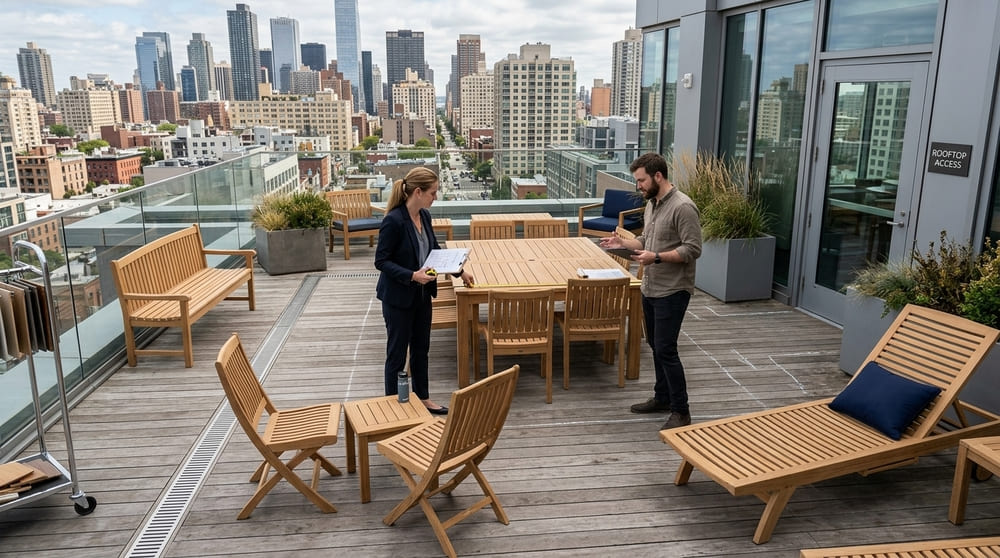
Furniture that works well in a garden or ground-floor terrace is not automatically suitable for a rooftop. The following checks can help hospitality and commercial buyers eliminate unsuitable options early and prepare more complete information before requesting product specifications or quotations.
Note: Rooftop structural capacity, wind safety, anchoring, and other building-related requirements must be evaluated by competent project professionals. Furniture specifications should be reviewed together with actual site and building conditions before installation.
1. Make Sure the Furniture Can Be Transported to the Rooftop
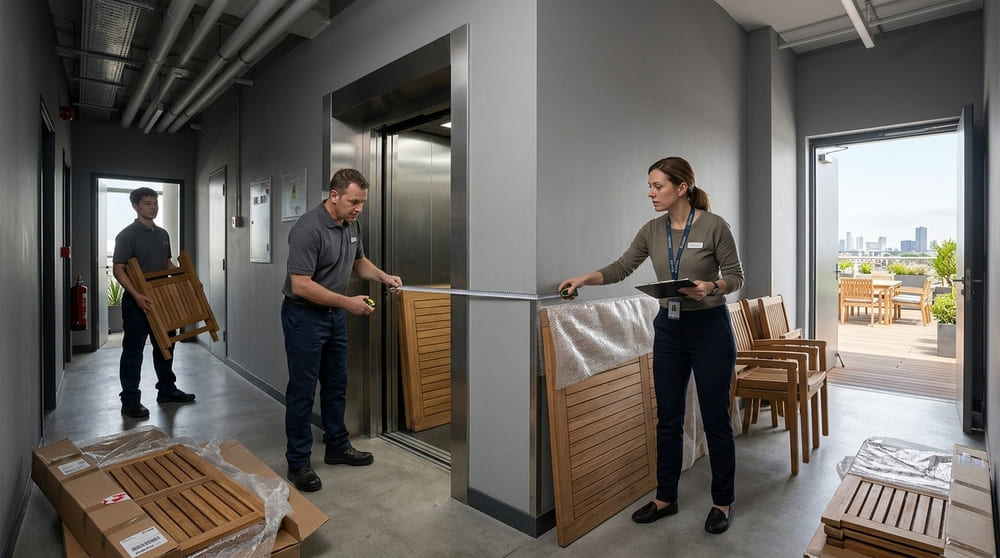
Check the complete delivery route before selecting a furniture model. A product may fit the rooftop layout but still be difficult or impossible to transport through the building.
Measure Lifts, Doors, Corridors, and Stairs
Record the width and height of openings as well as the available turning space. Compare these measurements with both the furniture dimensions and its packaged dimensions rather than checking only the size after installation.
Identify Products That Can Fold or Be Transported Compactly
When access is limited, folding furniture or models designed for compact transportation may provide additional options. However, do not assume that a product can be disassembled simply because its construction appears modular. Confirm the delivery configuration and assembly requirements with the manufacturer.
Determine an Alternative Route Before Ordering
If the furniture cannot use the primary route, coordinate any alternative lifting or delivery method with the building manager, contractor, and other competent parties before approving the order.
For the access review, record:
a. Lift dimensions
b. Door dimensions
c. Corridor width
d. Turning space
e. Stair dimensions
f. Equipment capacity, where relevant
g. Product dimensions
h. Packaged dimensions
i. Assembly requirements
2. Record the Dimensions and Weight of Each Product
Product dimensions and weight are necessary for access, layout, handling, and structural review. Catalogue photographs alone cannot provide enough information for rooftop planning.
Use Dimensions in the Actual Operating Position
For dining furniture, include the space needed when chairs are pulled out. For loungers and reclining chairs, check the dimensions in each position that will actually be used. Extendable furniture should also be evaluated in its extended configuration.
Request Product Weight Information
Record the weight per unit and planned quantity. Provide this information to the project team together with other relevant rooftop loads, such as users, planters, equipment, and additional elements.
Confirm Structural Capacity with a Competent Professional
There is no universal furniture quantity or weight that can be declared safe for every rooftop. Structural suitability depends on the building design, load distribution, existing conditions, applicable requirements, and professional assessment.
A simple project table can be used to organize the information:
| Product Code | Furniture Type | Open Dimensions | Folded Dimensions | Weight per Unit | Quantity | Placement Area | Approval Status |
| Model A | Chair | Record data | If applicable | Record data | Record quantity | Zone A | Pending/Approved |
| Model B | Table | Record data | If applicable | Record data | Record quantity | Zone B | Pending/Approved |
3. Match the Furniture with the Layout and Circulation
Build the rooftop layout using actual furniture dimensions rather than trying to fit the maximum possible number of products. Each item should remain usable without unnecessarily restricting guest or staff movement.
Define the Function of Each Zone
Separate dining, lounge, waiting, and event areas first. This allows rooftop outdoor furniture to be selected according to the activity in each zone rather than appearance alone.
Check Space While the Furniture Is Being Used
Allow for chairs being pulled out, loungers reclining, tables extending, and staff moving around occupied furniture. These operating dimensions can require more space than the furniture footprint shown in a closed or unused position.
Keep Important Routes Clear
Furniture placement should not interfere with doors, stairs, service access, drainage access, or safety routes established by the project team and building management.
For broader planning considerations, see how designers and contractors can match teak furniture with the project layout and surrounding site conditions.
4. Evaluate Wind Exposure and Furniture Stability
Rooftop wind conditions should be evaluated specifically for the project rather than assumed to be the same as ground-level outdoor areas. The project team needs to assess the furniture together with its location and exposure.
Do Not Judge Stability from Weight Alone
Furniture weight is only one consideration. Product height, shape, exposed surface area, center of gravity, leg configuration, orientation, and placement can also affect how the complete item responds to wind.
Pay Attention to Large or Elevated Surfaces
Tabletops, chair backs, umbrellas, and other accessories can present different surfaces to the wind. Evaluate the intended configuration as a whole rather than considering only the basic furniture frame.
Establish a Procedure for Deteriorating Weather Conditions
Determine in advance whether furniture will remain in position, be folded, moved, stored, or secured using a method approved for the project.
Avoid applying a universal wind-speed limit or anchoring method because requirements vary by site. Any solution that penetrates the rooftop surface also requires appropriate professional review because it may affect waterproofing or other building components.
A simple evaluation matrix can include:
| Placement Area | Exposure | Product Shape/Size | Normal Position | Bad Weather Procedure | Technical Approval |
| Dining area | Record condition | Record data | Fixed layout | Determine procedure | Required if applicable |
| Event area | Record condition | Record data | Flexible layout | Determine procedure | Required if applicable |
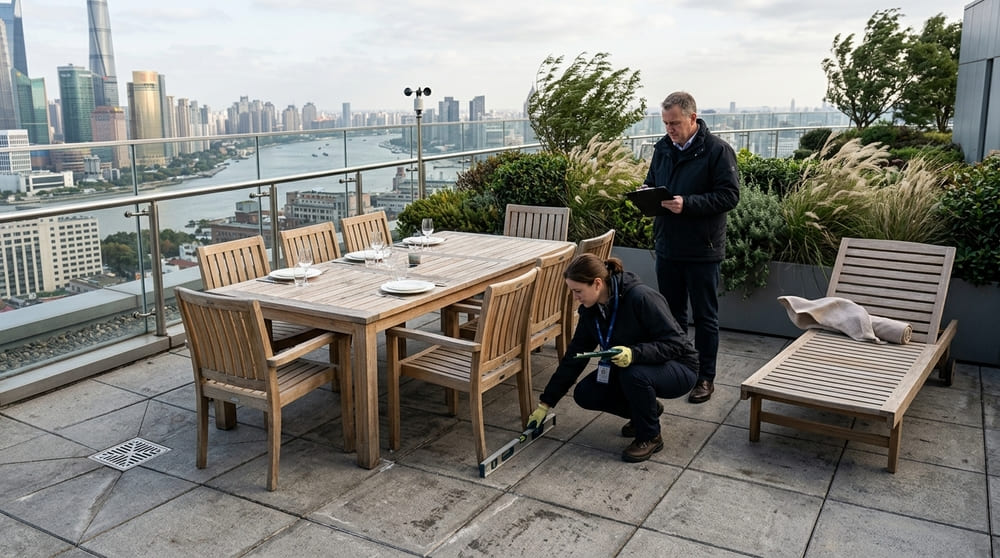
5. Check the Floor Condition and Drainage Routes
Furniture must remain compatible with the actual rooftop surface while keeping planned drainage accessible. Inspect the floor before finalizing product placement.
Check Slopes and Floor Joints
Test whether tables, chairs, or benches remain stable where the surface includes drainage slopes, joints, gaps, or minor elevation differences.
Keep Drainage Access Clear
Do not position furniture over floor drains or areas that need to remain accessible for drainage inspection and cleaning. Furniture layouts should work with the existing water-management plan rather than obstruct it.
Check Furniture Contact Points
Evaluate the shape and contact area of furniture feet, stability on the selected flooring, and the possibility of pressure marks or scratches. Any additional floor protection should be compatible with the flooring material and project requirements.
6. Plan How the Furniture Will Be Moved and Stored
Handling and storage should be planned before purchasing, especially when a rooftop changes function or requires specific procedures during adverse weather.
Determine Which Furniture Normally Remains in Place
Fixed chairs, fixed tables, benches, and teak sets may suit zones with stable layouts, subject to the project's structural, wind, and placement assessments.
Consider Flexible Products for Frequently Changing Areas
Folding chairs and tables can be considered for event areas or additional seating capacity. Their practical value depends on how easily staff can operate and move them and whether suitable storage is available.
Measure the Storage Area
Compare storage capacity with the product's dimensions in its intended storage configuration. Confirm whether the selected model is actually designed to fold, stack, or be stored in the proposed position.
Consider Staff Handling Requirements
Record product weight, suitable handling points, number of staff required, moving distance, and estimated setup process.
If flexibility is a major requirement, this guide to flexible teak furniture for limited outdoor spaces provides additional considerations for foldable and adaptable furniture.
7. Test a Sample Under Representative Rooftop Conditions
Evaluate a sample according to its intended rooftop use rather than judging it only in a showroom or indoor environment. The test should reproduce the most relevant access, placement, and handling conditions.
Check Compatibility with the Delivery Route
Use the sample and packaging dimensions to verify whether the planned transport route works in practice and whether staff can handle the product as expected.
Place the Sample on a Relevant Surface
Check stability and floor contact on the actual rooftop surface or a representative condition. Also confirm that its planned position does not interfere with drainage access.
Simulate Guest and Staff Use
Test normal actions such as sitting, pulling out chairs, adjusting backrests, extending tables, folding products, moving furniture, and placing it into storage where applicable.
Document the Approval Results
Record the product code, dimensions, weight, finish, mechanisms, intended placement, test findings, photographs, and any changes required before bulk production.
For a broader product-approval process beyond rooftop-specific checks, see why hospitality projects should approve furniture samples before bulk production.
Use a Checklist to Filter Rooftop Furniture Options
After completing the seven checks, compare every shortlisted product using the same criteria. This helps prevent design and price from becoming the only basis for the purchasing decision.
Record the following information for each candidate:
a. Product code and furniture type
b. Delivery access
c. Product dimensions and weight
d. Position in the rooftop layout
e. Structural review status
f. Wind review status
g. Stability on the intended flooring
h. Moving requirements
i. Storage location
j. Sample test results
Then assign one of these statuses:
a. Suitable: Product and site requirements have been met.
b. Needs additional data: Important product specifications are still missing.
c. Needs technical approval: Structural, safety, wind, or building-management review is still required.
d. Not suitable: The product cannot meet an important site limitation.
Frequently Asked Questions About Teak Furniture for Rooftop Areas
The following questions address several practical considerations that commonly arise when shortlisting furniture for an elevated outdoor area.
1. Is Heavy Teak Furniture Automatically Safe for a Rooftop?
No. Weight is only one factor. Structural capacity, wind exposure, product configuration, floor conditions, and placement still require project-specific evaluation.
2. Is Folding Furniture Better for Rooftops?
It can be useful when layouts change frequently and suitable storage is available. However, it is not automatically preferable for permanent dining or lounge zones.
3. Should Rooftop Furniture Be Anchored to the Floor?
Not automatically. Any securing or anchoring method should be determined by competent professionals based on wind conditions, structural requirements, flooring, and rooftop waterproofing.
4. How Do You Know Whether Furniture Will Fit in a Lift?
Compare the packaged product dimensions with the lift-door opening, cabin dimensions, rated capacity, and available maneuvering space along the entire route.
5. Should a Furniture Sample Be Taken to the Rooftop?
Where practical, testing on the actual rooftop or under representative conditions can help verify access, stability, layout compatibility, and handling before a larger order is approved.
Conclusion
Choosing teak furniture for rooftop areas should begin with building access, followed by product dimensions and weight, layout planning, and professional review of structural and wind conditions. Floor conditions, drainage, handling, storage, and sample performance should then be checked before final approval.
Bulk ordering should follow only after key product data is complete, site limitations have been identified, and any issues requiring technical approval have been resolved.
Prepare Your Rooftop Requirements Before Shortlisting Furniture
Prepare the rooftop layout, building-access dimensions, required capacity, placement conditions, and intended activities before selecting furniture. Share these details with Kusuma Furniture when discussing teak fixed chairs, folding chairs, extended tables, folding tables, benches, loungers, or teak sets so suitable options can be shortlisted for further review by your project team.
Recent Articles