2026-09-23 11:11:22
Fixed or Folding Teak Table Avoid the Wrong Choice for Your Hospitality Space
Choosing between a fixed vs folding teak table should depend on how each hospitality area operates. Hotels and restaurants can also combine both when permanent dining and flexible areas have different operational needs.
| Factor | Fixed Teak Table | Folding Teak Table |
| Layout | Best for relatively permanent arrangements | Best for frequently changing arrangements |
| Movement | Usually remains in its designated position | Designed for areas where tables need to be moved or stored |
| Storage | Does not require folding storage | Requires accessible and adequate storage |
| Setup | Minimal daily setup | Requires opening, positioning, and locking |
| Components to check | Legs, joints, tabletop | Legs, joints, hinges, folding and locking mechanisms |
| Suitable areas | Daily dining, permanent terraces | Events, multifunction areas, seasonal or overflow zones |
| Choose when | Consistency is the priority | Flexibility is genuinely needed |
The mechanism is only one part of the decision. Buyers should also compare table dimensions, seating capacity, actual product stability, floor conditions, staff handling, storage routes, and the specifications of each model before placing an order.
For hospitality properties with different types of spaces, the most practical decision may not be choosing only one table type. The following considerations can help determine which option fits each operational area.
Note: This article provides general guidance for choosing hospitality tables. Always confirm product dimensions, stability, folding mechanisms, and handling requirements with the manufacturer before ordering and use.
Choose Based on How Often the Layout Changes
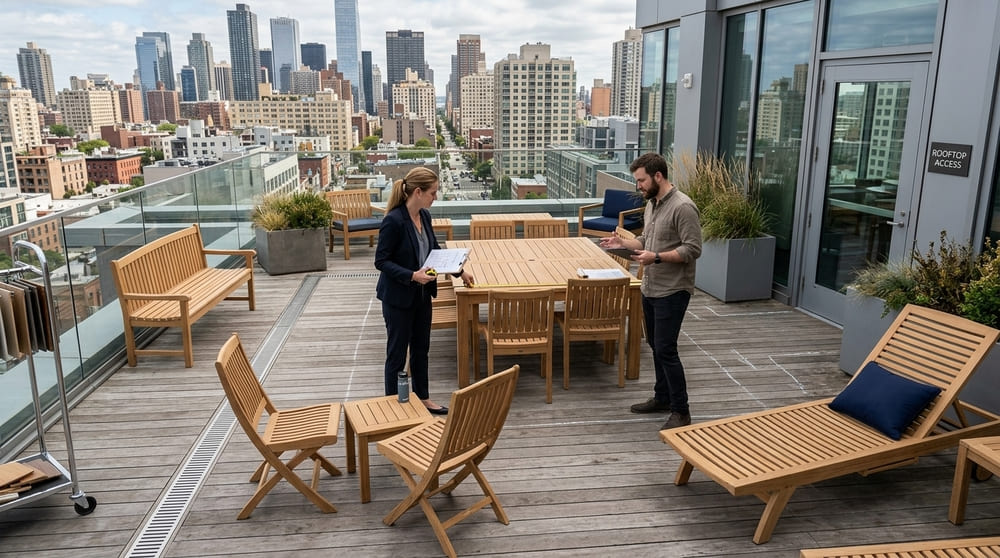
Layout frequency is one of the main factors when choosing between fixed and folding teak table. Start by identifying how often the area changes function, seating capacity, or furniture arrangement during normal operations.
If limited space is another reason your layout needs to change regularly, you can also read this guide to flexible teak furniture for limited outdoor spaces to understand how foldable and adaptable furniture can support different daily activities.
1. Fixed Table for Relatively Permanent Dining Layouts
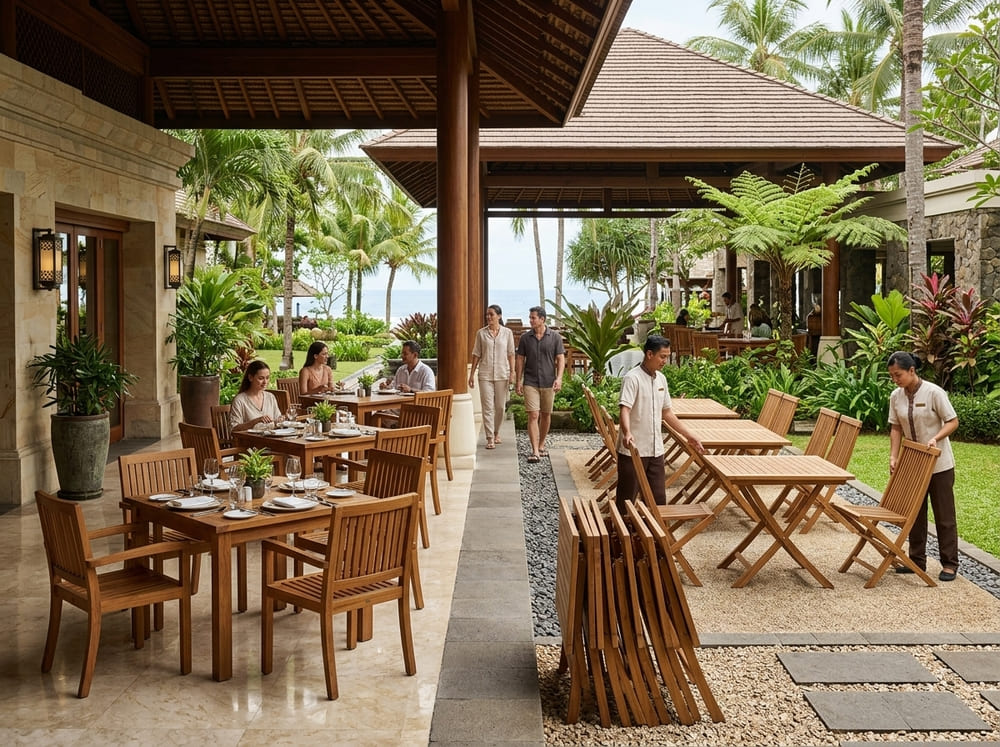
A fixed table is suitable when tables remain in a planned arrangement throughout daily operations. This can apply to restaurant dining areas, hotel terraces, or breakfast areas where seating capacity and circulation routes are already established.
2. Folding Table for Areas with Frequent Setup Changes
A folding teak table becomes more relevant when the same space regularly serves different purposes. Examples include event terraces, multifunction spaces, additional dining areas during busy periods, or locations that need to be cleared after use.
Consider the Stability Required During Use
Both table types need to remain stable during their intended use. Buyers should evaluate the actual construction and placement of each product rather than assuming stability only from the “fixed” or “folding” label.
1. Check the Table Legs and Floor Contact Points
Test the table on a surface representative of the actual project area. Outdoor terraces may contain joints, slopes, or slightly uneven surfaces that affect how the legs contact the floor.
A table that appears stable on a showroom floor may behave differently at the project location. Stability should therefore be checked together with the intended placement conditions.
2. Check the Locking Mechanism on Folding Tables
The folding and locking mechanism should be easy for staff to operate correctly and should keep the table securely open during use. The exact operation depends on the model.
Calculate the Staff Work Required to Move and Set Up Tables
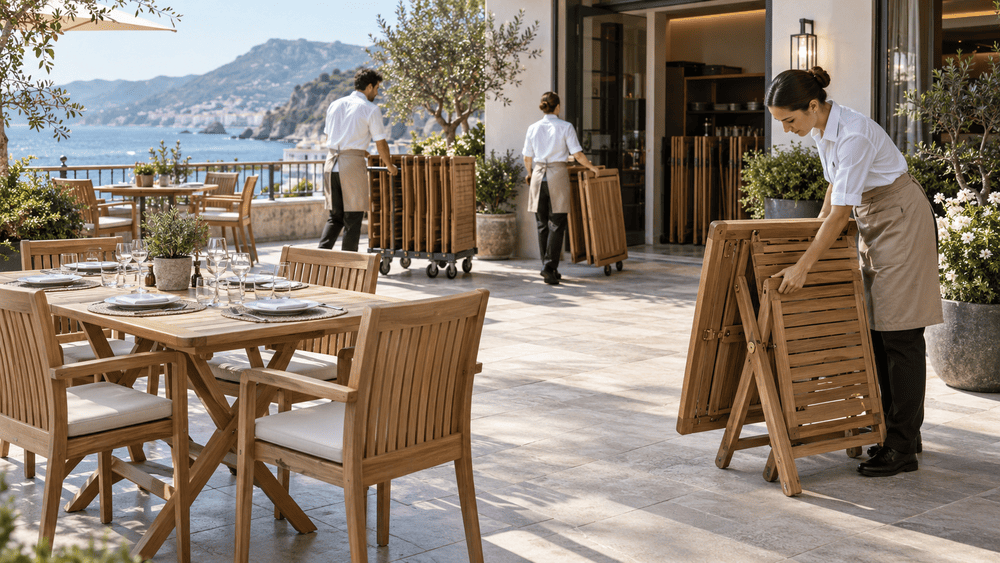
A folding table is only practical when the required handling fits the property's daily operations. If staff repeatedly carry, unfold, position, lock, close, and return tables to storage, those steps become part of the operational workload.
1. Check the Moving Route
Map the entire route between the storage area and the location where the tables will be used.
Check:
1. Product weight and dimensions
2. Distance to the storage area
3. Door and corridor widths
4. Stairs or lifts along the route
5. Tight corners or other obstacles
6. Whether furniture must pass through guest areas
7. Number of staff available for handling
8. Expected setup time
A folding table that stores compactly may still be inconvenient if moving it requires navigating stairs, narrow doors, or busy guest areas.
2. Evaluate How Easily the Table Opens and Closes
Staff should be able to understand how to open, lock, unlock, and close the table correctly. Test the actual product rather than evaluating the mechanism only from photographs or specifications.
Pay attention to hand placement and potential pinch points during operation. Staff should follow the manufacturer's instructions for the specific mechanism instead of improvising a setup procedure.
Make Sure Folding Tables Have Suitable Storage
The space-saving benefit of a folding table only becomes useful when there is an appropriate place to store it. Storage therefore needs to be considered before the product is ordered, not after the tables arrive.
1. Measure the Table When Folded
Ask for or verify both the open and folded dimensions. Compare the folded dimensions with the available storage space and the entire route leading to it.
2. Determine How the Tables Will Be Stored
Plan where and how each table will be positioned when it is not in use. Storage should avoid unnecessary pressure or contact that could damage the tabletop, hardware, or folding components.
Do not assume that every folding table should be stacked or stored in the same position. Follow the handling and storage requirements of the selected model.
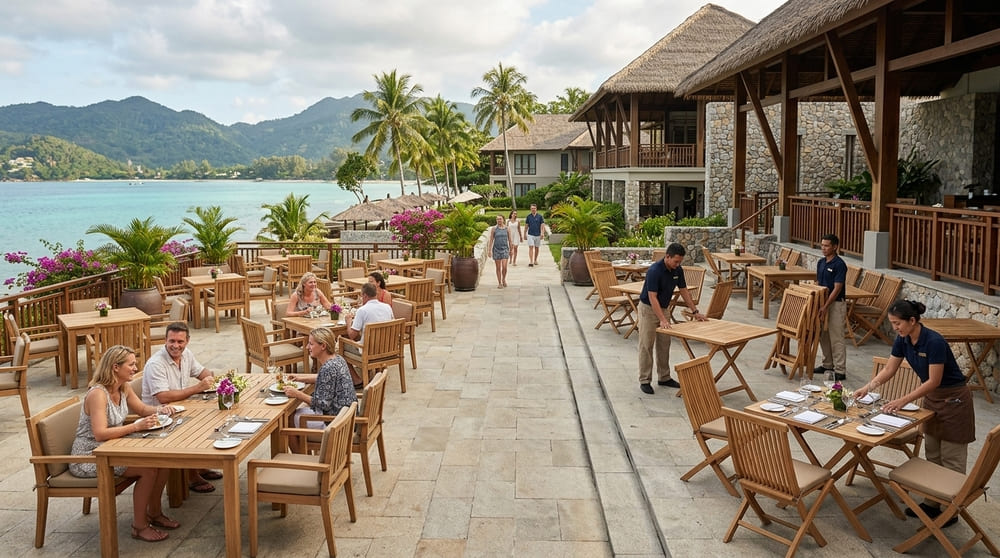
Match Table Size with Capacity and Circulation
Whether the table is fixed or folding, its dimensions still need to work with the intended number of guests and surrounding circulation. The mechanism should not distract from basic layout planning.
1. Determine the Number of Users per Table
First determine whether each table is intended for two, four, six, or more guests. Then test the intended capacity using the actual dimensions of both the table and the chairs that will accompany it.
2. Leave Space for Chairs, Guests, and Staff
A usable table footprint includes more than the tabletop. Guests need space to pull chairs out and sit, while staff need clear routes to carry food and beverages.
A simple project comparison sheet can help verify each candidate:
| Product Code | Table Shape | Dimensions | Capacity to Test | Chair Size | Area | Circulation Check |
| Model A | Square | Verify product | 2–4 guests | Verify chair | Terrace | Pass / Revise |
| Model B | Rectangular | Verify product | 4–6 guests | Verify chair | Restaurant | Pass / Revise |
Consider Component Checks in Daily Use
Fixed and folding tables require slightly different checks because their construction differs. This section does not replace the maintenance instructions for a particular product, but it helps buyers understand what components will require attention during use.
1. Checks for Fixed Tables
For a fixed table, focus on:
1. Stability of joints
2. Condition of the legs
3. Tabletop condition
4. Changes that cause wobbling or interfere with normal use
2. Checks for Folding Tables
For a folding table, also check:
1. Folding mechanism
2. Locking mechanism
3. Hinges
4. Fasteners
5. Ease of opening and closing
Moving components make correct operation particularly important. Any product-specific inspection should follow the manufacturer's instructions.
Determine the Table Type for Each Hospitality Area
One table type does not have to be applied throughout the entire property. Match the decision to the function and operational pattern of each zone.
1. Daily Dining Areas
Fixed tables generally suit areas where the number of tables, seating capacity, and layout remain relatively consistent throughout daily operations.
2. Event and Multifunction Areas
Folding tables can be considered when the space regularly changes for receptions, meetings, private dining, or other events.
3. Seasonal Terraces or Additional Areas
Folding tables can provide additional capacity when needed, provided the property has suitable storage and a practical setup procedure.
4. Outdoor Areas Without Layout Changes
Fixed tables can be prioritized when an outdoor hospitality table will remain in the same position and there is little operational reason to fold or store it.
The matrix below can help classify each area before selecting products.
| Area | Main Function | Frequency of Use | Layout Changes | Storage Need | Capacity | Initial Choice |
| Main restaurant | Daily dining | Daily | Low | Low | Based on layout | Fixed |
| Event terrace | Events/dining | Variable | High | High | Variable | Folding |
| Overflow area | Extra seating | Seasonal | Medium–high | High | Variable | Folding |
| Permanent terrace | Outdoor dining | Daily | Low | Low | Based on layout | Fixed |
Use this as a decision framework rather than a universal rule. The actual product still needs to be evaluated against the project's dimensions, construction, and operational requirements.
Combine Fixed and Folding Tables If Areas Have Different Needs
Hotels and restaurants can combine fixed and folding tables when the property contains both permanent and flexible zones. This allows each table type to serve a specific operational purpose.
This approach also prevents a property from introducing folding mechanisms in areas where tables rarely move, while still maintaining flexibility where layout changes are genuinely useful.
Check the Actual Product Before Placing an Order
Final selection should be based on the actual product, not only the table category. Compare dimensions, stability, construction, mechanism, handling requirements, chair compatibility, and fit within the intended layout.
For folding models, test opening, locking, closing, and carrying the table. For fixed models, check stability and placement within the planned area.
Hospitality buyers can compare Kusuma Furniture's fixed teak table collection and folding teak table collection before shortlisting models for further project evaluation.
FAQ About Fixed vs Folding Teak Tables
The following questions address common considerations when deciding between these two table types for hospitality spaces.
1. Are Folding Tables Always Better for Limited Spaces?
No. Their space-saving benefit depends on whether the tables are actually folded and whether the property has a practical moving route and storage area.
2. Are Fixed Tables More Stable Than Folding Tables?
A fixed table has no folding mechanism, but stability should still be evaluated based on the actual construction, joints, condition, and floor surface. A folding table should additionally be checked with its mechanism fully opened and locked.
3. Can Folding Tables Be Used Every Day in a Restaurant?
They can, provided the selected model is suitable for the intended usage pattern and staff can operate its mechanism correctly. Daily operational requirements should be discussed with the manufacturer before selection.
4. Can Fixed and Folding Tables Be Used in the Same Area?
Yes. They can be combined when each has a clear function and the resulting layout, capacity, dimensions, and appearance remain coordinated.
5. What Is the Difference Between a Folding Table and an Extendable Table?
A folding table is designed so parts of the table can be folded to support handling or storage, depending on its design. An extendable table changes the usable tabletop size to accommodate different seating requirements.
Conclusion
Choose a fixed teak table when the area is used consistently, the layout rarely changes, and there is no operational need to fold and store the furniture. Choose a folding teak table when changing configurations is genuinely part of the area's operation and suitable storage and handling procedures are available.
If a property has both permanent dining and flexible event or overflow zones, combine the two according to each area's function. Before ordering, verify dimensions, capacity, stability, moving routes, storage, staff handling, and the construction of the shortlisted models.
Choose the Table Around How Your Hospitality Space Actually Operates
Hotel, resort, restaurant, and café teams can prepare their area function, layout dimensions, guest capacity, setup frequency, and storage requirements before selecting a table. Share these project details with Kusuma Furniture to compare suitable fixed tables and folding teak table models and determine the quantity required for each hospitality area.
Recent Articles