2026-09-15 17:10:34
How to Choose Safe Outdoor Furniture for Children
Safe outdoor furniture for children should be stable, free from sharp edges, dangerous gaps, and easily detachable parts, and appropriately sized for its users. Safety also depends on surface temperature, ground conditions, furniture placement, moving mechanisms, and regular inspections after exposure to weather and repeated use.
A small chair or a product marketed as children's furniture is not automatically safe. Children may lean on tables, pull chairs, climb onto benches, reach into gaps, or touch surfaces that have become hot in direct sunlight.
For this reason, child-friendly outdoor furniture should be evaluated through its design, construction, dimensions, surroundings, and foreseeable use—not appearance alone.
Check the Safety Standards Relevant to the Furniture Type
The appropriate safety standard depends on the product type, intended age group, market, and how the furniture will be used. Buyers should identify the relevant standard before applying specific dimensions or test criteria.
For children's seating, EN 17191:2021 is an important reference. It covers seating specifically intended for children who can walk and sit independently, including chairs, benches, reclining chairs, and folding chairs for indoor and outdoor use. Its requirements and test methods address areas including surfaces and edges, entrapment hazards, moving parts, stability, strength, and durability.
The EN 581 series is another reference for outdoor seating and tables. EN 581-1 specifies general safety requirements for outdoor furniture intended for camping, domestic, and contract use by adults, while related parts address mechanical safety for seating and tables. It should therefore be applied according to the actual product scope rather than treated as a children's furniture standard.
Standards such as EN 71 and ASTM F963 apply to toys, while EN 1176 applies to playground equipment. ASTM F963, for example, specifically covers toys intended for children under 14 and excludes playground equipment; furniture is also outside its normal scope unless the item is considered a toy counterpart.
Therefore, buyers should request information about the intended age group, stability and strength testing, folding-mechanism safety, entrapment checks, and detachable components.
Use a Safety Checklist Before Choosing Outdoor Furniture
A practical checklist helps buyers evaluate both the product and its surroundings before selecting safe outdoor furniture for children.This checklist can also be used as a routine inspection sheet for family areas, hospitality spaces, schools, or other commercial facilities. Use the checklist before choosing outdoor furniture:
1. Corners and Edges: No sharp, rough, or protruding edges.
2. Stability: Does not wobble or tip easily.
3. Gaps: No gaps that could trap fingers or body parts.
4. Components: No loose screws, caps, or small parts.
5. Moving Mechanisms: No accessble pinch points.
6. Size: Suitable for the intended users.
7. Surface: Smooth, splinter-free, and safe to touch.
8. Finishing: Suitable for outdoor use and not peeling.
9. Placement: Away from active running or high-risk areas.
10. Condition: Remains safe after weather exposure and repeated use.
Choose Furniture Without Sharp Corners and Edges
Corners and edges should minimize injury risk if a child accidentally bumps into the furniture. Inspect tabletops, armrests, backrests, legs, and structural parts positioned around children's head or body height. Rounded or smoothly finished edges are preferable to sharp projections or rough corners.
Make Sure the Furniture Does Not Wobble or Tip Easily
Stable construction is essential because children may use furniture differently from adults. Check the leg position, base width, weight distribution, joints, and overall rigidity. Consider foreseeable behavior such as leaning against a table edge, pulling a chair, or attempting to climb onto a bench.
Check Gaps That Could Trap a Child's Body Parts
Openings between furniture components can create entrapment hazards. Inspect gaps between slats, backrests, armrests, joints, and areas beneath tables and chairs. Avoid applying one universal gap measurement unless it comes from the standard and test method applicable to that specific product.
Avoid Small Components and Hardware That Can Come Loose
Hardware that becomes loose can create additional hazards even if the furniture was secure when first installed.
Inspect bolts, screw caps, decorative parts, cushion buttons, stoppers, and other accessible components. Outdoor exposure and repeated movement can gradually loosen parts, making regular inspection important.
Check Folding Furniture and Moving Parts
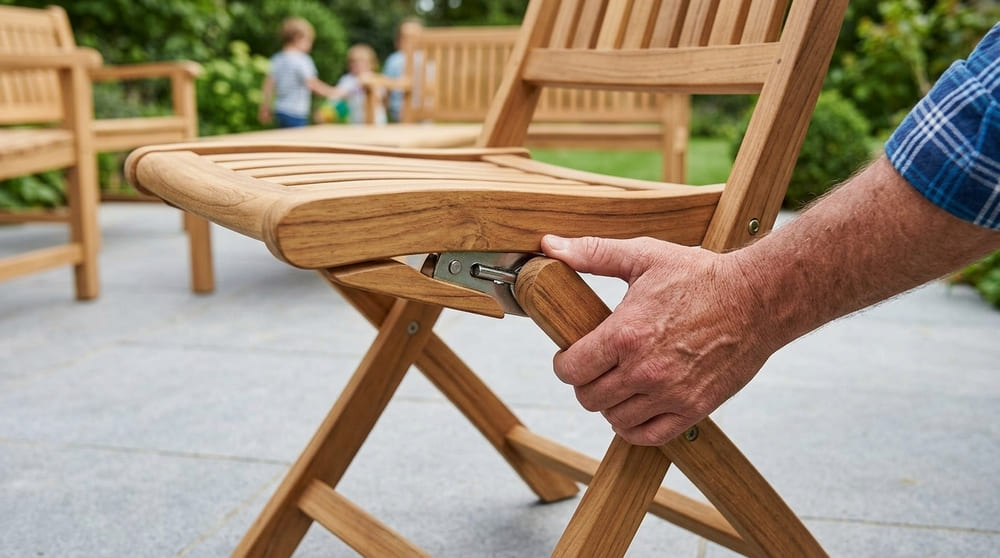
Folding and reclining mechanisms require extra attention because moving components can create pinch or shear points.
Check hinges, folding tables, folding chairs, reclining backrests, and sliding components. Locking mechanisms should remain secure during use and should not be easily released accidentally by a child.
For more considerations when evaluating folding furniture, see Kusuma Furniture's guide to choosing durable, space-saving folding teak chairs.
Match Table and Chair Size to the Child's Age
Furniture dimensions should allow children to sit down, use the surface, and leave the seat without unnecessary difficulty.
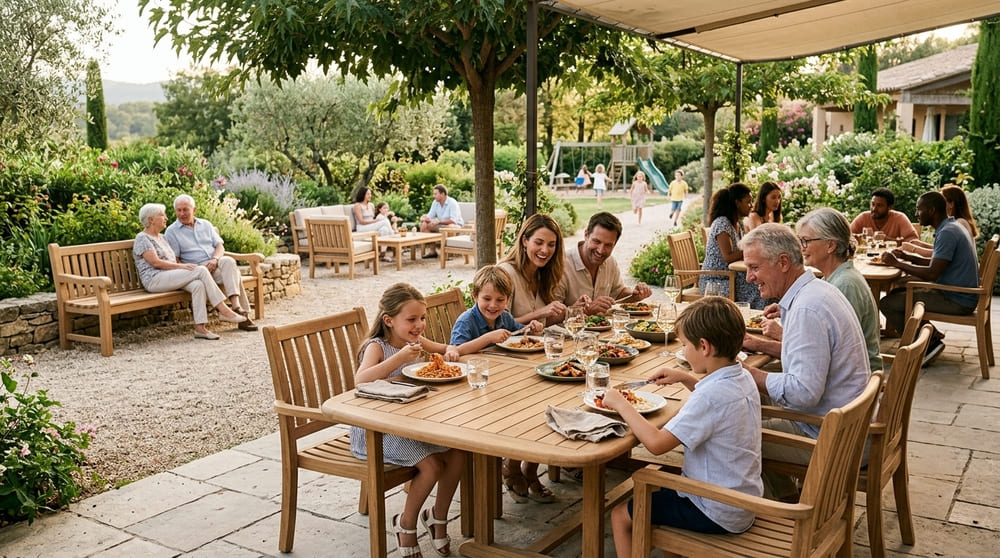
For dedicated children's areas, choose dimensions according to the intended age range and product guidance. In family areas where adults and children share furniture, adult-sized furniture may still be used when the layout and supervision are appropriate.
Choose Smooth, Splinter-Free Surfaces
Outdoor wooden furniture needs surface inspection because weather can change its condition over time. Check for raised grain, splinters, cracks, protruding screws, and peeling finishes. Rain, sunlight, humidity, and repeated use can make a previously smooth surface require maintenance.
Check Surface Temperature Before Use
Outdoor furniture can become uncomfortable or potentially hazardous after prolonged direct sunlight, particularly on exposed hardware or heat-absorbing surfaces.
Before children use the area, an adult should check the seat, tabletop, armrests, and metal components by touch. Do not rely only on air temperature; direct solar exposure can make individual surfaces considerably hotter.
Where heat exposure is frequent, provide shade or reposition the furniture. Kusuma Furniture also discusses practical shade solutions for outdoor seating exposed to daytime heat.
Place Furniture on Level and Stable Ground
Furniture stability also depends on the surface beneath it. Check grass, soil, paving, decking, and flooring for uneven areas or gaps. Furniture legs should not sink into soft ground, become caught between decking gaps, or start wobbling after heavy rain.
Keep Furniture Away from Running and Play Routes
The safest furniture can still become an obstacle when positioned in the wrong place. Keep tables, chairs, benches, and loungers away from active running routes where possible. Also consider their distance from swimming pools, stairs, level changes, playground zones, and service circulation.
Secure Cushions and Outdoor Accessories
Loose accessories can introduce hazards unrelated to the furniture frame itself. Check cushions, ties, umbrellas, furniture covers, and decorations. They should not slide unexpectedly, create trip hazards, block sightlines, or leave loose cords within easy reach of children.
Recheck Furniture After Weather Exposure
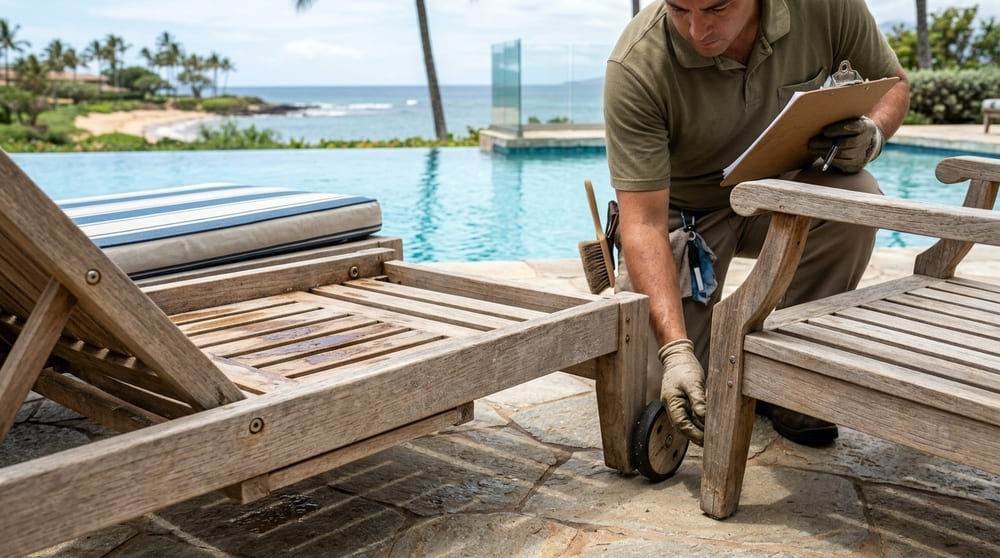
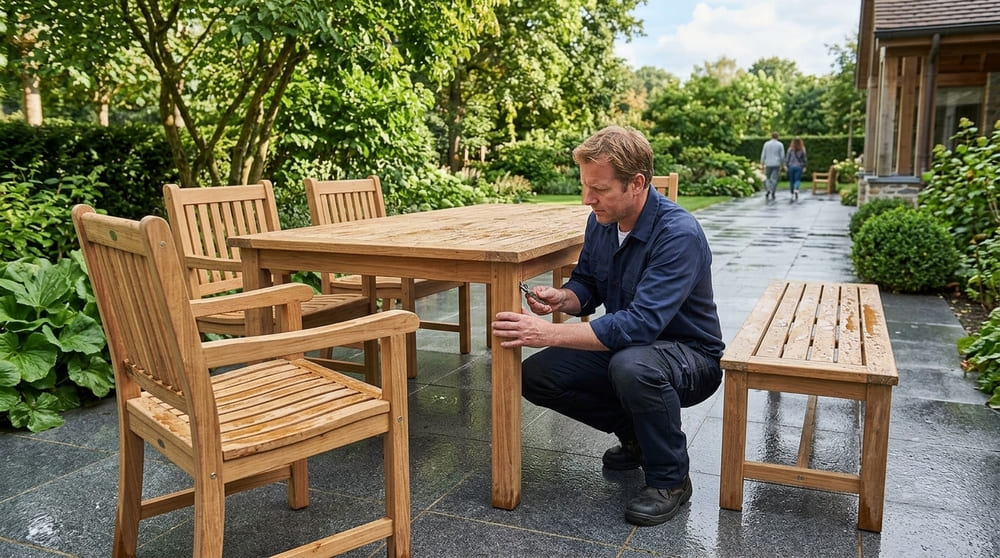
Outdoor furniture safety requires ongoing inspection because the condition of a product can change after installation. After severe weather or heavy use, check joints, hardware, cracks, rough areas, mold, unstable legs, and moving mechanisms. More frequent inspection may be appropriate for commercial spaces with high daily use.
Temporarily Remove Unsafe Furniture from Use
Furniture with a safety-related defect should not remain available while waiting for routine maintenance.
Remove or restrict access when you find loose structural joints, broken parts, splinters, protruding hardware, damaged mechanisms, torn cushions that expose components, or unstable legs. Return the product to service only after the problem has been corrected.
Avoid Common Mistakes When Choosing Outdoor Furniture for Children
Avoid these common assumptions:
1. A smaller product is automatically safer.
2. Attractive shapes and colors are enough.
3. Gaps and moving mechanisms do not need inspection.
4. Very lightweight furniture is always suitable for children.
5. Corner protectors can compensate for an unsafe basic design.
6. Furniture can be placed directly beside active play routes.
7. Safety does not need to be reassessed after weather exposure.
FAQ About Safe Outdoor Furniture for Children
These questions can help parents and project buyers make a more complete safety assessment.
1. Does Outdoor Furniture for Children Have to Be Small?
Not always. Dimensions should suit the intended age and use. In shared family spaces, children may use standard furniture when it can be used safely and appropriate supervision is provided.
2. Is Wooden Outdoor Furniture Safe for Children?
It can be. Safety depends on construction, surface condition, finish, joints, maintenance, and suitability for outdoor exposure—not the material name alone.
3. Do Table Corners Need Corner Protectors?
Not necessarily. Corner protectors can provide additional protection but should not replace safer furniture design. Outdoor heat, rain, and humidity can also weaken their attachment.
4. Are Folding Chairs Safe for Children?
They require careful assessment. Check that the locking system is reliable and accessible moving parts do not create avoidable pinch points. Follow the intended age range and product instructions.
5. How Can You Tell Whether Outdoor Furniture Is Too Hot?
An adult should physically check the seat, tabletop, armrests, and exposed hardware before use. Surfaces in direct sunlight may be hotter than the surrounding air suggests.
6. How Often Should Outdoor Furniture Be Inspected?
It depends on weather exposure and use. Add inspections after severe weather, relocation, unusually heavy use, or any noticeable change in stability or surface condition.
7. Does Child-Friendly Furniture Need Safety Certification?
Applicable requirements depend on the product, market, and project. A "child-friendly" claim should not be treated as equivalent to compliance with a safety standard or independent testing.
Conclusion
If the furniture is intended primarily for children, evaluate its dimensions, edges, stability, gaps, components, and moving mechanisms against the appropriate product requirements. If it will be used in a shared family or commercial area, also assess surface temperature, ground conditions, placement, and changing condition over time. A sturdy appearance alone does not prove that outdoor furniture is safe for children.
Plan Outdoor Furniture Around How the Area Will Be Used
Parents, architects, contractors, hotels, resorts, restaurants, schools, and project buyers can discuss user profiles, activities, site conditions, and required furniture dimensions with Kusuma Furniture. Fixed chairs, folding chairs, extended tables, folding tables, bench, and outdoor set options can then be considered according to the needs of family and child-oriented outdoor areas without assuming that a particular product automatically meets a specific children's safety standard.
Recent Articles