2026-09-23 13:11:54
Before Buying Poolside Furniture Check These 7 Teak Furniture Specifications
Before buying teak furniture for a poolside area, check these seven poolside teak furniture specifications:
1. Furniture type and intended guest activity, including sitting or reclining position and duration of use.
2. Water-shedding design, including surfaces, gaps, joints, and areas where water may collect.
3. Hardware materials and protection, including fasteners, hinges, wheels, and moving components.
4. Stability on the actual pool deck, including slopes, joints, and floor conditions.
5. Safety of moving mechanisms, particularly on loungers, reclining chairs, folding furniture, and wheeled products.
6. Ease of staff handling, including weight, dimensions, grip points, moving routes, and storage.
7. Sample suitability under representative poolside conditions, including dimensions, comfort, stability, operation, and handling.
Teak is commonly selected for outdoor furniture because of its natural resistance to moisture and outdoor exposure. However, the wood material alone does not determine whether a lounger, chair, or table will work well beside a swimming pool. The complete product design and the way it will be used also matter.
For a broader explanation of how location affects furniture selection, this guide to matching teak outdoor furniture with project layout and site conditions provides additional considerations for designers and contractors.
Note: This article provides a general pre-purchase checklist. Product construction, mechanisms, hardware, stability, and handling requirements should always be verified using the actual model, manufacturer information, and project conditions before ordering.
1. Match the Furniture Type with Guest Activities
Start with what guests will actually do in each poolside zone before selecting a product. Swimming, sunbathing, relaxing, waiting, drinking, and dining require different body positions, furniture dimensions, and supporting surfaces.
Lounger for Longer Reclining and Relaxation
A teak lounger is relevant for sunbathing and relaxation zones where guests may remain in a reclining position for longer periods.
Check the total footprint at each available backrest position. A lounger that fits when upright may require more space when fully reclined.
For a more specific product comparison, see how to compare teak loungers and steamer chairs for poolside use.
Reclining Chair for Adjustable Sitting Positions
A reclining chair can be considered when guests need several sitting positions without requiring furniture as long as a lounger.
Test how the adjustment mechanism operates and how much clearance the chair requires in different positions.
Fixed Chair and Table for Dining or Refreshment Areas
Poolside dining and refreshment zones generally require a more upright sitting position and a stable surface for food, drinks, and personal belongings.
Use a simple comparison table before shortlisting products:
| Guest Activity | Duration | Body Position | Typical Items | Side Table Needed? | Furniture Type | Space Required |
| Sunbathing | Longer | Reclining | Towel, phone, drink | Optional | Lounger | Verify layout |
| Relaxing | Medium–long | Adjustable | Drink, book | Optional | Reclining chair | Verify positions |
| Dining | Short–medium | Upright | Food, drinks | Main table | Fixed chair + table | Verify circulation |
2. Check Whether the Design Can Shed Water
Poolside furniture should be evaluated for how water leaves the complete product, not only for the moisture resistance of teak itself. Rain, pool splashes, and water carried by guests can reach surfaces, joints, hardware, and undersides.
Kusuma Furniture's guide on teak and water resistance also explains why water resistance should not be interpreted as complete waterproofing.
Check Gaps on Seating and Table Surfaces
Gaps between teak slats can provide paths for water to leave horizontal surfaces. Check the actual arrangement and spacing rather than applying one universal gap measurement to every furniture design.
Identify Areas That May Hold Water
Inspect board intersections, joints, recesses, hardware locations, and other details where water or debris could remain after the surrounding surface has dried.
Check Whether the Underside Can Dry
Look beneath the product as well. Air should be able to reach relevant areas, and the furniture should not be positioned in a way that keeps vulnerable sections continuously in contact with wet surfaces.
3. Identify Hardware Materials and Protection
A poolside product includes more than teak. Screws, bolts, fasteners, hinges, locks, wheels, and reclining mechanisms may also be exposed to moisture and substances associated with pool operations.
Record All Visible and Hidden Hardware
Ask for information about hardware located at joints, beneath the furniture, around wheels, and inside folding or reclining mechanisms.
This prevents important components from being overlooked simply because they are not immediately visible.
Match Hardware to the Exposure Conditions
A product directly beside the pool may experience different exposure from one under a covered terrace or farther from the water.
Instead of specifying one metal grade for every project, record the exposure conditions and confirm whether the hardware material or finish offered by the manufacturer is suitable for them.
Check Hardware Accessibility
Components that require routine inspection should be reasonably accessible without unnecessarily dismantling the main furniture structure.
Use the following information when comparing models: component name, location, function, offered material or finish, expected exposure, and details that still need manufacturer confirmation.
4. Test Stability on the Pool Deck Surface
Furniture should be evaluated on a surface that represents its actual placement conditions. A stable product on a flat showroom floor may behave differently on a pool deck with drainage slopes, joints, texture, or small elevation differences.
Check All Furniture Contact Points
Place the product in its intended position and check whether its legs support it consistently without unwanted rocking during normal use.
Consider the Surface Slope
Pool decks may incorporate slopes as part of their drainage design. This makes actual placement conditions relevant when evaluating a chair, table, or lounger.
For example, the U.S. Department of Justice's ADA Standards include specific slope requirements for certain clear deck spaces around accessible pool features, demonstrating that pool decks are not always treated as perfectly level surfaces. The applicable requirements for an actual project depend on its jurisdiction and design.
Check Contact with Wet Flooring
Evaluate the shape and condition of the furniture feet and how they contact the intended surface. Avoid assuming universal slip performance unless the product and surface have been evaluated using relevant criteria.
5. Check the Safety of Every Moving Mechanism
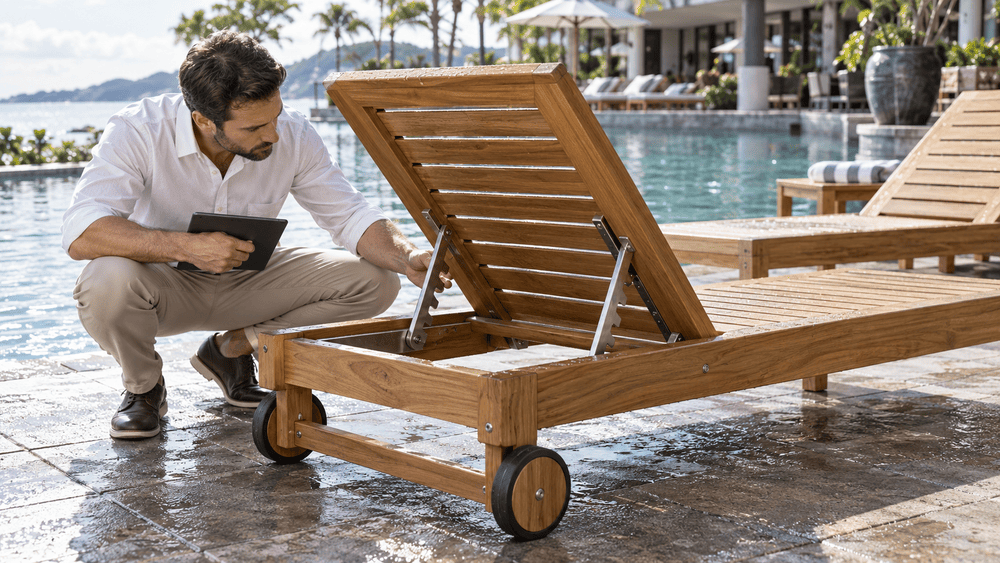
Moving components need to be tested through their full intended operation before the furniture is selected. This is particularly important for loungers, reclining chairs, folding products, and furniture with wheels.
Test Position Adjustment
Move an adjustable backrest through its available positions and check whether each intended position engages correctly. Evaluate it from the user's perspective rather than operating the mechanism only while the furniture is empty.
Buyers can also review Kusuma Furniture's teak loungers with adjustable positions when shortlisting product types.
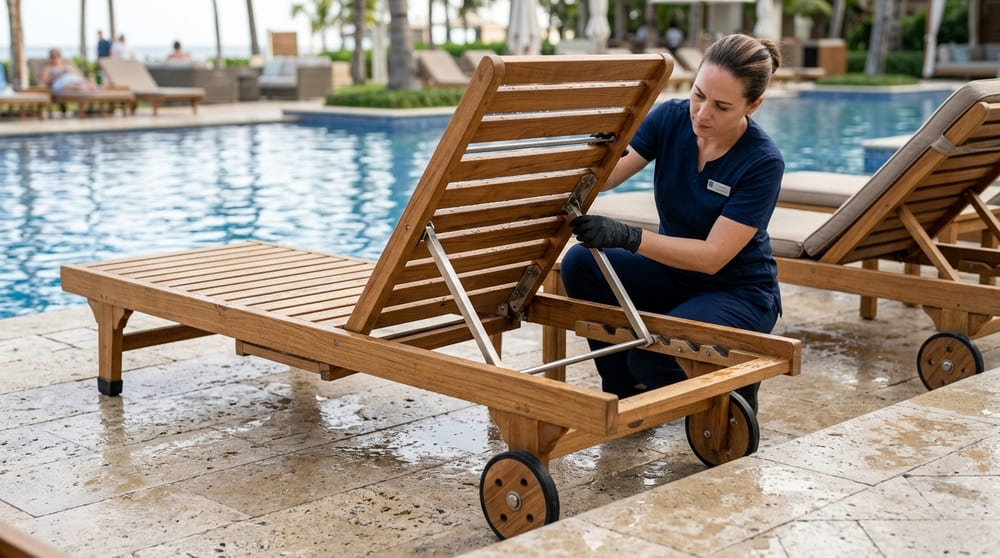
Identify Potential Pinch Points
Observe where components meet as the backrest, legs, or frame move. Areas where fingers could enter during adjustment require particular attention during product evaluation and operation.
Check Wheels and Moving Components
If a product has wheels, inspect their position, rotation, attachment, and how easily staff can control the furniture on the intended surface.
Make Sure Staff Understand the Operation
Staff should know the correct points for adjusting, lifting, pushing, or folding each model. Clear product-specific instructions help prevent incorrect handling of moving components.
6. Evaluate How Easily Staff Can Move the Furniture
Poolside furniture may need to move for cleaning, layout changes, weather preparation, or events. Handling requirements should therefore be evaluated before purchasing multiple units.
Check Weight, Dimensions, and Grip Points
Record the product's weight and overall dimensions, then identify appropriate grip or handling points according to the product design.
Map the Route to Storage
Before ordering, check:
1. Product weight and dimensions
2. Number of staff required
3. Appropriate grip points
4. Moving distance
5. Doors and corridors
6. Turns, stairs, lifts, or surface changes
7. Routes through guest areas
8. Storage-room dimensions
Determine the Storage Position
Confirm whether the available storage area accommodates the product in the recommended position. Do not assume every lounger or reclining chair can be folded or stacked.
7. Evaluate a Sample Under Representative Poolside Conditions
A sample should be evaluated according to its intended location and use, not only its appearance or finish. Poolside-specific testing helps identify practical issues before a larger order is approved.
Place the Sample on a Relevant Surface
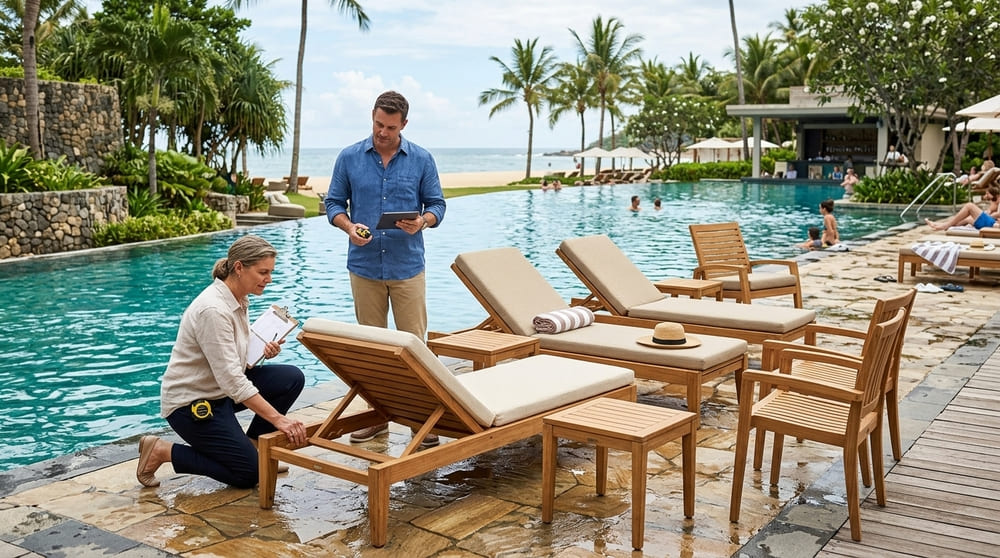
Where possible, test the sample on the same or a representative pool-deck material and slope. Check stability, leg contact, and the space required around the product.
Simulate How Guests Will Use the Product
Test sitting, reclining, adjusting the backrest, placing typical belongings, and getting up from the furniture. Using several representative users can reveal practical differences that are difficult to identify from drawings alone.
Simulate Staff Handling
Have staff test the planned process for carrying, pushing, adjusting, folding, or storing the furniture where applicable.
Document the Approval Results
Record the product code, dimensions, finish, hardware, mechanism positions, inspection results, photographs, and any changes that must be resolved before bulk production.
For a more complete approval process beyond poolside-specific checks, see why hotel projects should approve furniture samples before bulk production.
Use a Checklist to Compare Several Models
After checking the seven specifications, place shortlisted products in one comparison matrix. This makes it easier to identify missing information and prevents appearance or price from becoming the only basis for selection.
| Product | Activity | Dimensions | Water Shedding | Hardware | Stability | Mechanism | Handling | Sample Test | Status |
| Model A | Record use | Verify | Check | Confirm | Test | Test if applicable | Evaluate | Record | Suitable / Confirm |
| Model B | Record use | Verify | Check | Confirm | Test | Test if applicable | Evaluate | Record | Adjust / Unsuitable |
Use four simple statuses:
1. Suitable: Specifications and test results meet the area's requirements.
2. Needs confirmation: Important information is still required from the manufacturer.
3. Needs adjustment: The product may work if the required modification is feasible.
4. Not suitable: An important project requirement cannot be met.
FAQ About Poolside Teak Furniture Specifications
These questions cover several common considerations before selecting teak furniture for hotel and resort pool areas.
1. Is All Teak Furniture Suitable for Placement Beside a Swimming Pool?
No. Suitability also depends on product design, hardware, stability, mechanisms, handling requirements, and the conditions where the furniture will be placed.
2. Does Poolside Furniture Need Gaps Between the Slats?
Gaps can help water leave the surface, but they are only one part of the design. Buyers should also inspect joints, undersides, hardware areas, and other places where water may remain.
3. Are Wheeled Loungers Better for Poolside Areas?
Not automatically. Wheels may assist with movement, but their attachment, operation, stability, and compatibility with the pool-deck surface should still be checked.
4. Does Poolside Furniture Need to Be Easy to Move?
It depends on the property's operations. Consider cleaning routines, weather preparation, layout changes, events, and storage before deciding how important mobility is.
5. Should a Furniture Sample Be Tested at the Project Site?
Testing under actual or representative conditions is useful because it allows buyers to evaluate stability, dimensions, operation, comfort, and staff handling before approving a larger order.
Conclusion
Do not select teak poolside furniture based on the wood material and appearance alone. Start with guest activities, then check water-shedding details, hardware, stability, moving mechanisms, staff handling, and sample performance under representative conditions.
A product should move forward to a bulk order only after these requirements are suitable for the intended area or any unresolved specifications have been confirmed with the manufacturer.
Prepare Your Poolside Requirements Before Choosing a Model
Before selecting poolside furniture, prepare the placement area, intended guest activities, pool-deck conditions, handling requirements, and required quantity. Share these details with Kusuma Furniture when discussing teak loungers, reclining chairs, fixed chairs, tables, and other suitable furniture options so each shortlisted model can be evaluated against the project's actual needs.
Referensi:
U.S. Department of Justice. (2010). 2010 ADA standards for accessible design. ADA.gov. https://www.ada.gov/law-and-regs/design-standards/2010-stds/
Recent Articles