
2026-09-14 19:35:15
Comparing Quotations vs Landed Cost for Teak Furniture from Indonesian Suppliers
To compare an Indonesian teak furniture quotation fairly, buyers should first align product specifications, order quantity, currency, Incoterms®, destination point, and included costs. Then calculate product, packaging, freight, import, and handling costs while accounting for potential damage. The final comparison should use cost per saleable unit rather than the quoted unit price alone.
A lower quotation does not necessarily mean a lower final cost. One supplier may offer a cheaper chair but use larger packaging, exclude certain export costs, or deliver fewer units in saleable condition, all of which can increase the actual cost per unit.
For that reason, comparing a quotation for furniture from Indonesia requires several steps: normalize the product specifications and commercial terms, calculate the landed cost of teak furniture, and then evaluate the supplier based on cost, risk, and overall value.
Align Product Specifications Before Comparing Prices
Two quotations should only be compared directly when the products and order requirements are equivalent. Differences in dimensions, teak specifications, construction, hardware, or included accessories can significantly affect wholesale teak furniture prices.
Make sure the following specifications are aligned:
- Product type and model
- Product dimensions
- Teak wood specifications
- Construction and joinery
- Finishing system
- Hardware materials
- Cushions or additional accessories
- Order quantity
- Quality standards
- Packaging format
For example, Supplier A may quote a lower price for a chair because its dimensions are smaller, its hardware specification differs, or cushions and export packaging are excluded.
Buyers planning larger sourcing programs can also review this guide to sourcing wholesale teak furniture from Jepara, Indonesia to identify other factors worth checking before placing an order.
Check Everything Included in the Quotation
A teak furniture supplier quotation should be evaluated based on its total scope, not just the product price. Buyers need to identify which components are included and which will generate additional charges later.
| Cost Component | Supplier A | Supplier B | Confirmation Needed |
| Product price | Included | Included | No |
| Export packaging | Included | Unclear | Yes |
| Cushions | Excluded | Included | No |
| Delivery to port | Included | Excluded | No |
| Inspection | Unclear | Included | Yes |
Other items worth checking include:
- Product design or customization fees
- Sample production costs
- Special finishes
- Hardware and accessories
- Product labels and codes
- Assembly instructions
- Export documentation
- Pre-shipment inspection
- Transportation from the factory
- Origin port charges
A quotation that clearly defines these components makes it easier to identify additional costs before the order is confirmed.
Use the Same Currency, Quantity, and Payment Terms
Quotations should be compared using the same currency, order volume, and commercial conditions. A price quoted for 100 units, for example, may not be comparable to a price based on an order of 500 units.
Buyers should check:
- Quotation currency
- Exchange rate assumptions
- Quotation validity period
- Minimum order quantity (MOQ)
- Quantity-based pricing
- Deposit requirements
- Final payment schedule
- Bank transaction fees
- Price adjustment policies
The quotation date also matters. Exchange rates, raw material prices, and freight costs can change, so quotations issued at different times may require normalization before comparison.
Understand the Incoterm and Delivery Point of Each Quotation
Incoterms® define important responsibilities, costs, and risks between seller and buyer. Therefore, an FOB quotation should not be compared directly with a CIF or DAP quotation based solely on the quoted total.
| Incoterm | General Scope | Typical Costs Remaining for Buyer |
| EXW | Goods are made available at the supplier's location | Collection, export process, freight, import, and destination transport |
| FOB | Seller delivers goods on board the vessel at the agreed port of shipment | Freight, insurance if required, import costs, and destination delivery |
| CIF | Cost, insurance, and freight are covered to the named destination port | Import-related costs, destination charges, and onward delivery |
| DAP | Goods are transported to the agreed destination and made available for unloading | Import clearance, duties, taxes, and other applicable import costs |
This table is only a practical summary. The final allocation of obligations, costs, and risks should follow the applicable Incoterms rule, the named port or place, and the sales contract agreed between both parties.
Calculate How Packaging and CBM Affect Freight Costs
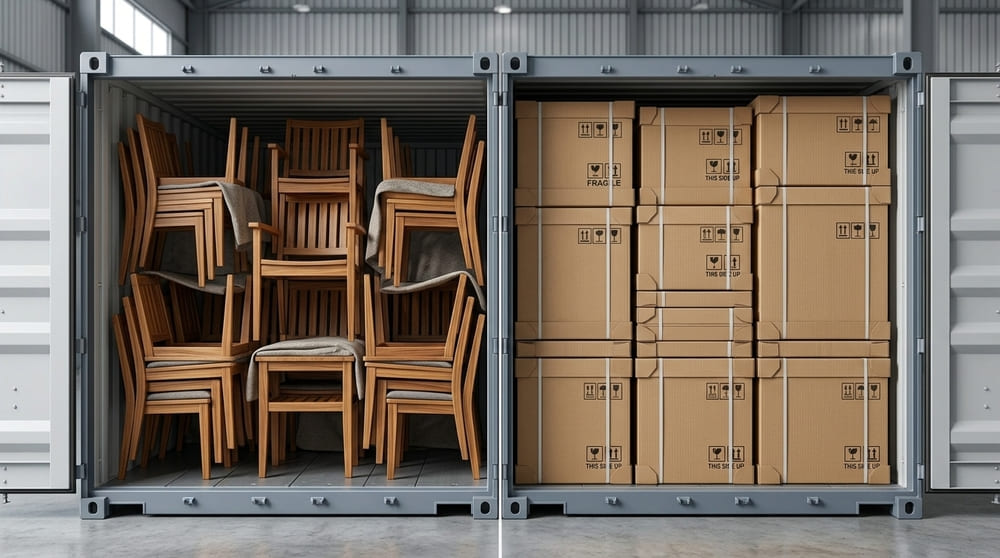
Packaging and CBM directly affect how many furniture units can fit into a shipment. A product with a higher unit price can still have a lower landed cost if its design and packaging allow more units to fit into the same container.
Buyers should compare:
- Flat pack or fully assembled
- Carton dimensions and quantity
- CBM per product and total order
- Units per container
- Loading efficiency
- Additional protective materials
- FCL or LCL requirements
For example, flat-packed furniture may use less container space than fully assembled products, reducing the freight cost allocated to each unit. Buyers can also compare the shipping space requirements of flat pack and fully assembled teak furniture before evaluating the final landed cost.
Freight cost per unit = Total freight cost ÷ Number of units loaded
Add All Costs Until the Furniture Reaches the Warehouse
The landed cost of teak furniture should include every relevant cost from the supplier to the comparison point selected by the buyer, such as a distribution warehouse.
Depending on the agreed commercial terms, these may include:
- Product price
- Export packaging
- Inland transport to the origin port
- Origin charges
- Ocean freight
- Cargo insurance
- Destination charges
- Customs clearance
- Import duties and taxes
- Inspection fees
- Port storage
- Inland delivery to the warehouse
- Unloading costs
Buyers should not apply one universal import tax assumption to every shipment. Applicable duties and taxes need to be verified based on the product classification or HS Code, destination country, trade arrangements, and regulations in force at the time of import.
Include Costs Incurred After the Products Arrive
For operational purposes, landed cost for teak furniture may not end when the shipment reaches the warehouse. Some products still require handling before they are ready for retail, distribution, or project installation.
Possible additional costs include:
- Unloading
- Incoming product inspection
- Warehouse handling
- Furniture assembly
- Packaging disposal
- Cushion or accessory installation
- Distribution to stores or project sites
- Temporary storage
- Minor repairs
These costs can become significant when purchasing hundreds of units, so they should be considered when comparing suppliers.
Calculate the Nominal Landed Cost per Unit
Nominal landed cost provides a basic average cost based on the total number of units ordered.
Nominal landed cost per unit = (product cost + packaging + shipping + import costs + handling costs) ÷ total units ordered
For example:
- Product cost: IDR 400,000,000
- Packaging and documentation: IDR 20,000,000
- Freight and insurance: IDR 70,000,000
- Import and destination costs: IDR 60,000,000
- Warehouse delivery and handling: IDR 25,000,000
- Order quantity: 500 units
Total cost to warehouse:
IDR 400,000,000 + IDR 20,000,000 + IDR 70,000,000 + IDR 60,000,000 + IDR 25,000,000 = IDR 575,000,000
Therefore:
IDR 575,000,000 ÷ 500 = IDR 1,150,000 per unit
These figures are illustrative and should not be used as actual freight, duty, or import cost benchmarks.

Calculate Effective Landed Cost Based on Saleable Units
For a more realistic sourcing comparison, buyers should calculate the effective landed cost based on units that can actually be sold or used after delivery.
The number of saleable units may be reduced by:
- Product damage
- Missing components
- Incorrect finishes
- Incorrect dimensions
- Hardware problems
- Moisture-related damage
- Products requiring repairs
- Delayed replacement products
Use the following formula:
Effective landed cost per unit = (total cost to warehouse + problem-handling costs) ÷ number of saleable units
Continuing the previous example:
- Total cost to warehouse: IDR 575,000,000
- Repair and issue-handling costs: IDR 10,000,000
- Saleable units: 480
The calculation becomes:
IDR 585,000,000 ÷ 480 = IDR 1,218,750 per saleable unit
Although the nominal cost was IDR 1,150,000 per unit, defects and additional handling increase the effective cost to IDR 1,218,750.
This difference illustrates why supplier performance can influence actual purchasing economics even when the initial quoted price appears attractive.
Compare Risk and Value Beyond Price
The best quotation is not necessarily the one with the lowest landed cost. Buyers should also evaluate whether the supplier can consistently meet specifications, delivery schedules, and quality expectations.
Important factors include:
- Specification compliance
- Quality consistency
- Production lead time
- Supplier capacity
- Packaging quality
- CBM efficiency
- Quality control procedures
- Export documentation
- Claims policy
- Replacement procedures
- Communication
- Export experience
International buyers can also review what global buyers look for when sourcing outdoor teak furniture from Indonesian manufacturers before evaluating potential suppliers.
Create a Final Supplier Comparison Table
Once the quotations have been normalized, consolidate the information into one comparison table. This makes differences in price, logistics efficiency, risk, and supplier terms easier to evaluate.
| Comparison Factor | Supplier A | Supplier B |
| Product specifications | Compliant | Compliant |
| Product price per unit | Lower | Higher |
| Export packaging | Additional cost | Included |
| Incoterm | FOB | FOB |
| CBM per unit | Higher | Lower |
| Estimated nominal landed cost | Calculate | Calculate |
| Estimated saleable units | Estimate | Estimate |
| Effective landed cost | Calculate | Calculate |
| Lead time | Enter data | Enter data |
| Claims policy | Enter data | Enter data |
| Main risks | Evaluate | Evaluate |
The final decision should balance effective landed cost, specification compliance, operational risk, and the supplier's ability to fulfil the order reliably.
Avoid These Mistakes When Comparing Furniture Quotations
A seemingly attractive export teak furniture price can become more expensive if important cost components are overlooked.
Avoid these common mistakes:
- Comparing products with different specifications
- Looking only at unit price
- Ignoring excluded quotation components
- Directly comparing different Incoterms®
- Failing to check CBM and loading capacity
- Using unverified import tax estimates
- Ignoring post-arrival costs
- Calculating landed cost only from ordered quantity
- Ignoring damaged or unsaleable units
A standardized comparison helps buyers identify where apparent savings come from and whether they remain savings after logistics and operational risks are included.
FAQ About Indonesian Teak Furniture Quotations and Landed Costs
Before requesting a final quotation, the following questions can help buyers establish a more consistent basis for comparing suppliers.
1. Is the quotation with the lowest product price always the most economical?
No. Packaging, CBM, freight, destination costs, assembly, and product damage can increase the final landed cost even when the initial unit price is lower.
2. Does a CIF price include all costs up to the buyer's warehouse?
Not necessarily. Buyers still need to check destination charges, customs clearance, import duties and taxes, and inland transportation from the destination port.
3. Why should buyers check CBM when purchasing furniture?
CBM represents the shipment volume occupied by the furniture. It affects loading capacity and can influence logistics costs per unit.
4. What is the difference between nominal and effective landed cost?
Nominal landed cost divides total costs by the number of units ordered. Effective landed cost also considers problem-handling costs and divides the total by the number of units actually fit for sale or use.
5. What information should buyers send to receive comparable furniture quotations?
Provide the product type, dimensions, material specifications, finish, hardware, quantity, packaging requirements, destination country or location, required schedule, and preferred Incoterm.
Conclusion
If suppliers offer different product specifications, normalize the specifications before comparing prices. If their quotations use different Incoterms or cost coverage, bring them to the same destination point first. Then compare the effective landed cost per saleable unit, quality consistency, and supplier risk rather than automatically selecting the lowest factory price.
Need a Clearer Teak Furniture Quotation for Your Next Order?
If you are a retailer, distributor, hospitality buyer, or project buyer sourcing wholesale teak furniture from Indonesia, send Kusuma Furniture your required product types, specifications, quantities, packaging preferences, and destination country. Kusuma Furniture can prepare quotations for chairs, tables, benches, loungers, and teak sets with clearer product and shipping requirements, helping you evaluate the order before moving forward.
Source: Freightos, Understanding Landed Cost and Profitability.
Recent Articles