2026-09-15 17:03:50
A Guide to Choosing Disability-Friendly Outdoor Furniture for Public and Commercial Spaces
Disability-friendly outdoor furniture should allow people to approach, use, and leave the furniture safely and as independently as possible. When selecting accessible outdoor furniture, consider wheelchair space, transfer access, support for sitting and standing, stability, visual contrast, and placement that keeps circulation routes clear.
An outdoor area may have an accessible path but still provide furniture that is difficult for some visitors to use. A table may be hard to approach with a wheelchair, while very low seating can make sitting down or standing up more difficult.
For this reason, inclusive outdoor furniture should be evaluated through three connected aspects: product design, furniture placement, and the actual experience of users with different mobility, balance, strength, or vision needs.
Use Accessibility Guidelines as a Reference
Use guidelines as an initial reference when evaluating accessibility. However, they are not specific certifications for outdoor furniture, and final technical requirements should still follow local regulations and project specifications.
1. The Principles of Universal Design encourage equitable use, sufficient space for approach and use, and designs that do not unnecessarily separate or stigmatize users.
2. ISO 21542:2021 Building construction: Accessibility and usability of the built environment provides requirements and recommendations related to accessibility in the built environment, including access and usability considerations around buildings.
3. For projects in the United States, the 2010 ADA Standards for Accessible Design provide technical criteria for accessible routes, clear floor space, dining surfaces, knee and toe clearance, and certain built-in elements.
These references are best used as a starting point for evaluation rather than proof that a particular product is automatically accessibility-compliant.
Use a Disability-Friendly Outdoor Furniture Checklist
Before purchasing accessible outdoor furniture, buyers should evaluate both the furniture and the surrounding area. To make this process easier, use the checklist here as a practical review sheet for project discussions, supplier comparisons, or on-site evaluations.
1. Approach Space: Clear and stable access to the furniture.
2. Wheelchair Space: Space for a wheelchair within the seating area.
3. Table Access: Enough clear space underneath the table.
4. Seat Design: Stable and easy to sit on.
5. Backrest and Armrest: Support for sitting, standing, or transferring.
6. Surrounding Surface: Firm, stable, and easy to move across.
7. Visibility: Furniture is easy to distinguish from its surroundings.
8. Layout: Does not block circulation or access routes.
9. Shared Use: Can be used comfortably with other people.
10. Outdoor Condition: Suitable for weather and outdoor exposure.
Match Furniture Features to Different User Needs
There is no single furniture design that suits every disability. Buyers should consider different needs instead of treating accessibility as one fixed specification.
| User Need | Features to Consider |
| Wheelchair user | Approach space, table clearance, position without a fixed chair |
| Cane or walker user | Clear route, stable seat, backrest, armrests |
| Difficulty sitting or standing | Seat that is not too low and stable support |
| Lateral transfer | Space beside the seat and options without armrests |
| Low vision | Visual contrast and predictable layout |
Provide Wheelchair Positions Within the Seating Area
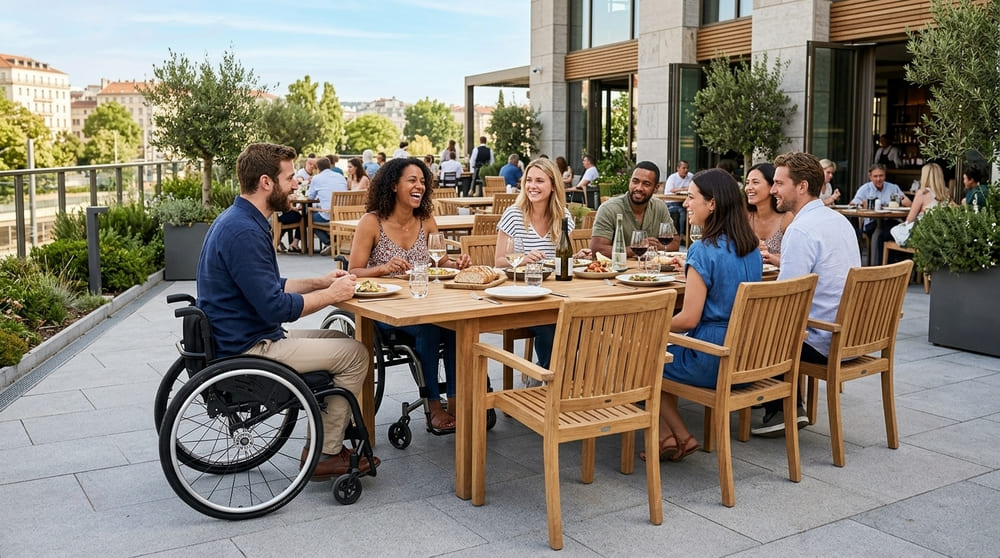
Wheelchair positions should be integrated into the main seating arrangement rather than placed separately. At restaurants, gardens, resorts, or public spaces, arrange tables, benches, or lounge areas so wheelchair users can sit with family or groups without blocking circulation.
Choose Tables That Wheelchair Users Can Approach
A wheelchair-accessible outdoor table needs more than empty space underneath. Check the tabletop height, table legs, support frames, cross-braces, and approach space. The user should be able to move close enough to use the table comfortably without structural elements blocking the wheelchair.
Choose Chairs That Make Sitting and Standing Easier
Stable seating with appropriate height, depth, back support, and firm construction can make sitting and standing easier for users with limited strength or balance.
Avoid making very low sofas or deep lounge chairs the only available seating. Hospitality buyers can also review Kusuma Furniture's guide to choosing teak furniture for hotels.
Provide Seating With and Without Armrests
Armrests can help some users maintain balance or push themselves up when standing. However, armrests may obstruct users who transfer laterally from a wheelchair. Providing both types gives visitors more choice.
Make Sure Benches Do Not Become Barriers
A disability-friendly garden bench should be evaluated together with the space around it. Check the bench location, backrest, armrests, stability, and available space beside it. A wheelchair or mobility aid should be able to remain nearby without narrowing the circulation path.
Check the Accessibility of Loungers and Lounge Furniture
Comfortable lounge furniture is not automatically easy to use for people with limited mobility.
Check seat height, depth, transfer space, stability, cushion firmness, and reclining mechanisms. Buyers can also compare formats in Kusuma Furniture's guide to teak loungers vs. steamer chairs.

Place Furniture on Firm and Stable Surfaces
Accessible furniture should sit on a surface that supports safe movement by wheelchairs, walkers, and other mobility aids. Avoid unstable, slippery, uneven, or heavily gapped surfaces. Also check whether water tends to collect around furniture legs.
Keep Approach Routes Free from Obstacles
An accessible layout can quickly become difficult to use if operational items are moved into the circulation area. Keep chairs, tables, umbrellas, planters, cushions, carts, and temporary equipment from narrowing routes to wheelchair accessible outdoor furniture.
Avoid Placing Furniture on Tactile Guidance Paths
Tactile guidance paths should remain clear for navigation. Furniture legs, pulled-out chairs, plants, decorations, and temporary items should not obstruct the path. Keep a consistent separation between seating areas and navigation routes.
Use Visual Contrast to Make Furniture Easier to Identify
Visual contrast can help some users with low vision distinguish furniture from the surrounding floor and landscape.
Consider contrast around seat edges, backrests, armrests, and furniture legs. Do not rely on color alone, predictable layout and unobstructed routes also matter.
Provide Accessible Seating in Shaded Areas
Accessible seating should be available in comfortable locations, not only in the hottest or most exposed area. Consider shade as well as distance from entrances, accessible toilets, service areas, and primary circulation routes.

Make Sure Furniture Remains Stable Outdoors
Outdoor furniture should remain stable when users sit, stand, transfer, or use it for support. Check legs, joints, hardware, and the risk of movement. For outdoor furniture for public spaces, materials and construction should also suit local weather, humidity, and usage intensity.
Do Not Treat Accessible Furniture as Medical Furniture
Accessible furniture can still match the design language of a hotel, resort, restaurant, garden, or public space. The goal is to reduce barriers without making users feel separated or singled out. Accessibility should be integrated naturally into the overall design.
Involve People With Disabilities in Furniture Evaluation
Technical checklists are useful, but they cannot represent every real-world experience.
Before applying one configuration across a large project, ask users with different mobility or vision needs to evaluate how easily they can approach, transfer, sit, stand, use the table, and leave the area.
Avoid Common Mistakes When Planning Disability-Friendly Outdoor Furniture
Common mistakes include:
1. Providing wheelchair space without a clear approach
2. Choosing tables with obstructive supports underneath
3. Providing only one armrest configuration
4. Blocking tactile guidance or circulation routes
5. Separating wheelchair users from their groups
6. Providing only low, deep lounge seating
7. Changing layouts without reassessing accessibility
FAQ About Disability-Friendly Outdoor Furniture
The following questions can help buyers perform an initial check before finalizing furniture specifications.
1. What Is Disability-Friendly Outdoor Furniture?
It is furniture designed and positioned so people with different mobility, vision, balance, or strength needs can approach, use, and leave it more easily.
2. Is a Table With Open Space Underneath Automatically Wheelchair Accessible?
No. Table height, structural supports, approach space, floor condition, and the route leading to the table also affect usability.
3. Should Every Accessible Chair Have Armrests?
No. Armrests can help some users sit or stand but may interfere with wheelchair transfer. Providing both options is more flexible.
4. Can Outdoor Sofas Be Part of an Accessible Layout?
Yes, if their height, depth, stability, and transfer space are suitable. However, very low sofas should not be the only seating option.
5. Can Tactile Guidance Paths Run Through Outdoor Furniture Areas?
The path should remain unobstructed. Furniture, planters, decorations, and operational items should not interfere with its function.
6. Does Disability-Friendly Outdoor Furniture Require Special Certification?
It depends on the project and local regulations. Accessibility claims, technical compliance, user testing, and formal certification should not be treated as the same thing.
7. How Can a Commercial Layout Stay Accessible After Opening?
Regularly check table and chair positions, circulation routes, tactile guidance paths, temporary equipment, and changes caused by daily operations or events.
Conclusion
If furniture will be used in a public or commercial space, evaluate product design, placement, and user experience together. If users can approach, use, and leave the furniture safely without being separated from others, the layout provides a stronger foundation for inclusive outdoor use.
Plan Outdoor Furniture Around User Needs from the Beginning
Architects, contractors, hotels, resorts, restaurants, public-space managers, and project buyers can discuss user needs, site conditions, and fixed chairs, folding chairs, extended tables, folding tables, bench, or loungers furniture specifications with Kusuma Furniture. Product adjustments can be discussed based on project requirements without assuming that Kusuma Furniture products automatically meet a particular accessibility certification.
Recent Articles