
2026-06-27 19:43:41
What Should Buyers Check During a Pre Shipment Inspection for Teak Furniture
Before teak furniture is shipped, buyers should verify product quantity, dimensions, wood condition, construction, moving mechanisms, finishing consistency, packaging, and shipment labels. A reliable pre-shipment inspection for teak furniture should also record measurements, photographs, videos, and written findings before the buyer authorizes container loading.
A product may look acceptable at first glance but still differ from the purchase order, technical drawing, approved sample, or packing requirements. These differences can create problems for retailers, distributors, hotel projects, contractors, and other commercial buyers after the shipment arrives.
This guide explains the documents buyers should prepare, seven inspection areas that require attention, suitable evidence for an inspection report, common inspection mistakes, and the steps to take when non-conforming products are found.
Why Is Pre-Shipment Inspection Important for Teak Furniture Orders?
Pre-shipment inspection helps buyers identify product discrepancies while the furniture is still at the factory. At this stage, repairs, replacements, repacking, and additional testing can usually be completed more efficiently than after the goods have been loaded and shipped.
The main benefits include:
- - Repairs are easier to complete while the products remain at the factory.
- - Buyers receive evidence of the product condition before shipment.
- - The risk of disputes after delivery can be reduced.
- - Finished products can be compared with the approved sample.
- - Inspection findings can support a pass, pending, or fail decision.
- - Container loading can be postponed when important corrections remain incomplete.
Pre-shipment inspection is particularly important for custom products, mixed-model orders, new suppliers, and commercial projects with strict dimensional or finishing requirements. Buyers who are evaluating an Indonesian supplier may also review what global buyers look for when sourcing outdoor teak furniture from Indonesian manufacturers.
Documents to Prepare Before Starting the Inspection
The inspection will be more accurate when the inspector has clear reference documents. Visual judgment alone is not enough to determine whether the finished products match the order.
The following documents should be available before the furniture factory inspection begins:
- - Purchase order
- - Proforma invoice or commercial invoice
- - Product specification sheet
- - Technical drawing
- - Approved sample or golden sample
- - Approved color and finishing list
- - Packing specification
- - Shipping marks and product labels
- - Agreed dimensional and quality tolerances
- - Assembly instructions, when applicable
- - Approved hardware and accessory list
A golden sample is a product sample that has been approved by the buyer and retained as a reference during production and inspection. It helps reduce differences in interpretation between the buyer, supplier, production team, and inspector.
The approved sample should represent more than the general product appearance. When possible, it should also confirm the agreed dimensions, construction details, finishing tone, hardware, accessories, and packaging method.
7 Things Buyers Should Check During a Teak Furniture Pre-Shipment Inspection
A complete teak furniture inspection before shipping should cover the products, packaging, and supporting shipment information. The following seven areas help buyers evaluate whether the order matches the approved requirements.
1. Match the Product Quantity and Models with the Purchase Order
The inspection should begin by matching the actual product quantity, models, sizes, and variants with the purchase order. This is particularly important when one shipment contains fixed chairs, folding chairs, reclining chairs, loungers, benches, tables, and teak sets.
Check the following details:
- - Quantity of each model
- - Product name or item code
- - Product dimensions
- - Color and finishing variation
- - Number of cartons
- - Quantity per carton
- - Hardware and accessories
- - Replacement parts, when included
- - Assembly guides
- - Shipping marks
The inspector should not rely only on the total carton count. Selected cartons should be opened to confirm that the products, quantities, accessories, and labels inside match the information printed on the packaging.
For buyers managing multiple furniture categories, a clearly coded packing list can also make the teak furniture export quality check more efficient.
2. Measure the Product Dimensions and Production Tolerances
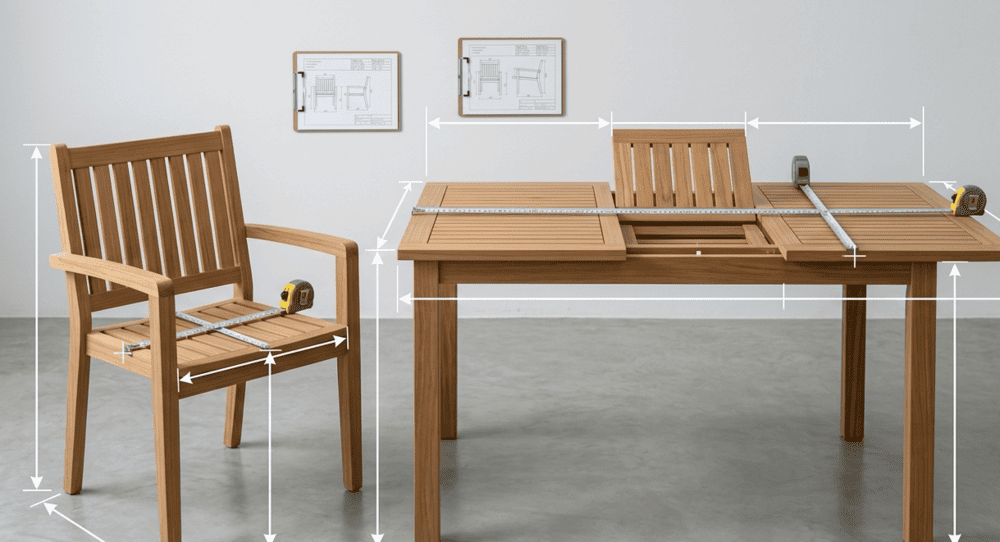
Actual product measurements should be compared with the approved technical drawing or specification sheet. Small dimensional differences can affect comfort, assembly, storage, layout planning, and compatibility with other furniture.
For chairs, measure:
- - Overall height
- - Overall width
- - Overall depth
- - Seat height
- - Seat width
- - Seat depth
- - Armrest height
- - Backrest height
- - Distance between legs
For tables, measure:
- - Table length
- - Table width
- - Table height
- - Tabletop thickness
- - Distance between table legs
- - Clearance beneath the tabletop
- - Dimensions when the extension is closed
- - Dimensions when the extension is fully opened
The inspector should photograph the measuring tool, measurement point, and product code in the same frame whenever possible. This makes the inspection evidence easier to verify.
Buyers evaluating this product category can also learn more about extendable teak tables for outdoor dining areas.
3. Inspect the Wood Condition and Visible Surface Defects
The inspector should check the wood condition and visible surfaces on samples from each production batch. The inspection should focus on defects that can be observed or measured without damaging the furniture.
Check for:
- - Cracks in the wood
- - Holes or visible surface defects
- - Splinters
- - Uneven surfaces
- - Visible sanding marks
- - Excessive gaps between joined components
- - Excessive color variation
- - Rough or sharp edges
- - Glue residue
- - Dents caused during handling
- - Moisture content, when included in the agreed specification
Sharp edges, splinters, and rough areas require particular attention on armrests, seat edges, tabletops, corners, and frequently touched surfaces.
When moisture measurement is part of the agreement, the inspector can use a moisture meter on several products and at several points. The product code, measurement location, reading, and inspection date should be included in the report.
There is no single moisture-content figure that should be treated as a universal standard for every teak furniture order. Suitable requirements may vary according to the destination country, storage environment, product construction, shipping conditions, and agreement between the buyer and manufacturer.
4. Test the Construction, Joints, and Furniture Stability
Finished furniture should feel stable, balanced, and secure during normal use. The inspector should test the products on a flat surface rather than assessing their construction only while they remain in the production or packing area.
Check the following:
- - Chair stability on a flat floor
- - Table stability after assembly
- - Joint tightness
- - Screw and hardware placement
- - Armrest strength
- - Backrest stability
- - Equal leg lengths
- - Loose components
- - Abnormal sounds during normal loading
- - Visible movement at the joints
- - Alignment between connected components
The inspection should not rely on appearance alone. Construction problems may be hidden beneath the seat, tabletop, frame, or connecting components.
Construction details are not always visible at first glance. Buyers can learn more about hidden design flaws that reduce the lifespan of commercial outdoor furniture.
For knock-down furniture, one or more samples should be disassembled and assembled again. A product that is stable during the first assembly may become misaligned after repacking or may be difficult to assemble using the supplied hardware.
The reassembly test should confirm that:
- - Holes remain properly aligned.
- - Hardware can be installed without excessive force.
- - Assembly instructions are understandable.
- - The assembled product remains stable.
- - Components are not damaged during normal assembly.
5. Operate Every Folding, Reclining, and Extension Mechanism
Products with moving components must be operated during the inspection. The inspector should not simply confirm that the parts are present; each mechanism should be opened, closed, adjusted, and locked several times.
Folding Chair Inspection
Check whether:
- - The chair opens and closes smoothly.
- - The mechanism locks securely.
- - The moving parts do not create an obvious finger-trapping area.
- - The chair remains stable when fully opened.
- - The hardware does not become loose after repeated operation.
- - The folded chair can be packed according to the approved method.
For additional product-selection considerations, buyers can review this guide to choosing durable, space-saving folding teak chairs.
Reclining Chair and Lounger Inspection
Check whether:
- - The backrest can be adjusted smoothly.
- - Each position locks correctly.
- - The hardware remains secure.
- - Moving parts do not rub excessively.
- - The frame stays stable in every position.
- - The user can return the product to its original position safely.
Extended Table Inspection
Check whether:
- - The extension leaf opens and closes properly.
- - The tabletop remains level.
- - Gaps between panels remain within the agreed tolerance.
- - The supporting mechanism functions correctly.
- - The table remains stable after extension.
Components do not scrape, jam, or shift during operation.
Where practical, record a continuous video showing the product code and the complete operating process. This provides stronger evidence than separate photographs of the product in different positions.
6. Compare the Finishing and Color Consistency Across the Batch
Finishing should be compared with the approved sample and across several products from the same batch. Adequate lighting is necessary because color differences, stains, coating gaps, and application marks can be difficult to identify in a dark warehouse.
Check the following:
- - Color matches the approved sample.
- - Gloss level is consistent.
- - All required surfaces are coated.
- - There are no stains or drip marks.
- - Brush or spray marks are not excessive.
- - The surface feels smooth.
- - Corners and underside areas have been checked.
- - Color differences between components remain within the agreed tolerance.
- - Repaired areas do not appear significantly different.
- - Product pairs or sets have a visually consistent appearance.
Several units should be placed side by side during the wholesale furniture quality control process. Batch inconsistencies are easier to identify when the products are viewed as a group rather than individually.
This is particularly important for retailers, hotel groups, and restaurant chains that display the same furniture model across multiple locations. Buyers can explore the causes of inconsistent furniture results across different locations.
7. Check the Packaging, Labels, and Container Loading Readiness
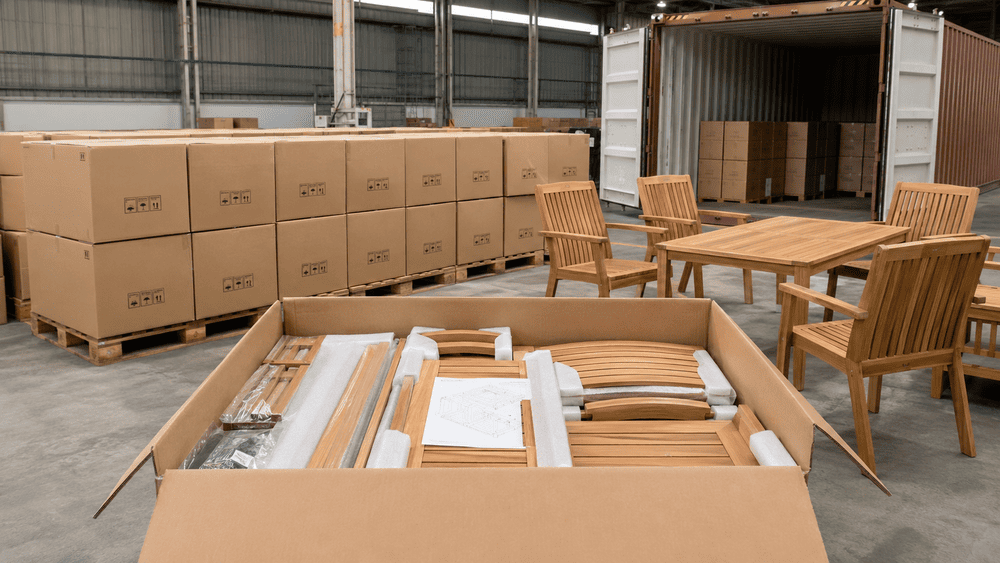
The inspection does not end when the furniture passes its product-quality checks. Packaging must protect the order during factory handling, storage, container movement, sea transport, and unloading.
Check whether:
- - Surfaces are protected from scratches.
- - Corners have additional protection.
- - Hardware is packed separately and labeled.
- - Assembly instructions are included when required.
- - Carton dimensions and strength match the product.
- - Products do not move excessively inside the packaging.
- - Shipping marks are easy to read.
- - Product codes match the contents.
- - Carton numbers are correct.
- - Cartons are dry and undamaged.
- - The packing sequence matches the agreed specification.
- - Fragile or movable parts receive sufficient protection.
- - The package can be opened without easily damaging the product.
The inspector can request that one selected carton be opened and repacked during the inspection. This helps confirm whether the packing sequence is clear, repeatable, and practical for the production team.
Container loading inspection should be arranged separately when the buyer also wants to verify:
- - Container cleanliness and dryness
- - Container wall, roof, floor, and door condition
- - Carton count during loading
- - Loading sequence
- - Space utilization
- - Product movement prevention
- - Final container seal number
Pre-Shipment Inspection Checklist for Teak Furniture
A structured furniture pre-shipment inspection checklist helps buyers, inspectors, and suppliers record the same information consistently.
| Inspection Area | What Should Be Checked? | Evidence to Record |
| Quantity | Models, product quantity, carton quantity, accessories | Checklist, carton list, and photographs |
| Dimensions | Actual measurements compared with the technical drawing | Photographs showing measuring tools and product codes |
| Wood Condition | Cracks, surface defects, splinters, gaps, and moisture content if agreed | Close-up photographs and measurement results |
| Construction | Joints, stability, screws, hardware, armrests, and legs | Photographs and testing videos |
| Mechanism | Folding, reclining, extension, and locking systems | Continuous operating videos |
| Finishing | Color, texture, gloss level, coating coverage, and batch consistency | Side-by-side comparison photographs |
| Packaging | Protection, labels, hardware, assembly guide, and carton condition | Photographs of opened and closed cartons |
| Loading Readiness | Packing sequence, carton identification, container condition, and loading plan | Loading checklist, photographs, and seal information |
The checklist should be adjusted to the product type. A fixed teak bench, for example, does not require a reclining mechanism test, while an extended table requires additional dimensional, alignment, and operating checks.
How Many Products Should Be Inspected?
Not every unit must always be opened and examined individually. The inspection quantity can be determined according to the total order, number of models, product complexity, supplier history, project risk, and sampling method agreed with the inspection party.
Factors to consider include:
- - Total number of products
- - Number of models in the order
- - Quantity per model
- - Complexity of moving mechanisms
- - New product or repeat order
- - Custom or standard specification
- - Supplier quality history
- - Order value
- - Destination requirements
- - Buyer-specific inspection rules
Products with folding, reclining, locking, or extension mechanisms may require a larger inspection proportion than repeatedly produced fixed furniture. New models and custom designs also deserve closer inspection because there is less production history available.
A buyer may increase the sample for the folding chairs and extended tables because these models contain moving components. The inspection plan should therefore combine proportional sampling with product-risk considerations.
What Evidence Should Be Included in the Inspection Report?
An inspection report should provide evidence that the buyer can review before approving shipment. It should clearly connect each finding with the relevant product model, quantity, and specification.
The report should include:
- - Inspection date and location
- - Factory or supplier name
- - Purchase order number
- - Product names and item codes
- - Total quantity available
- - Production completion status
- - Number of samples inspected
- - Product measurements
- - Photographs of product condition
- - Videos of mechanism testing
- - Packaging photographs
- - List of findings or discrepancies
- - Quantity affected by each finding
- - Corrective-action recommendation
- - Pass, pending, or fail status
- - Repair evidence before loading
- - Inspector’s name or inspection-party information
Each finding should be specific. Instead of writing “finishing problem,” the report could state that “four of ten inspected chairs showed visible coating gaps beneath the front armrests.”
Whenever possible, a measurement photograph should show the product, measuring tool, measurement result, and product code in one frame. This reduces the risk of evidence being assigned to the wrong model.
Common Mistakes During Furniture Pre-Shipment Inspection
Several inspection mistakes can leave important problems undiscovered even when an inspection has technically been completed.
What Should Buyers Do When the Inspection Finds a Problem?
Buyers do not always need to cancel the shipment when a problem is discovered. Each finding should first be documented and classified according to its effect on safety, function, appearance, assembly, packaging, or compliance with the approved specification.
The buyer can take the following steps:
- 1. Record each finding clearly and specifically.
- 2. Identify the model, quantity, and batch affected.
- 3. Group the findings according to their severity.
- 4. Determine which products must be repaired, replaced, or separated.
- 5. Request a corrective-action plan from the supplier.
- 6. Set a deadline for completing the corrections.
- 7. Request photographs or videos showing the repairs.
- 8. Conduct a re-inspection when the finding is significant.
- 9. Approve container loading only after the agreed requirements are met.
A minor cosmetic issue on a hidden surface may require a different response from an unstable joint, incorrect product dimensions, or non-functioning locking mechanism. Acceptance decisions should follow the buyer’s approved standards rather than being made informally during the inspection.
When several products show the same problem, the buyer should also ask whether the supplier has checked the remaining units. Correcting only the inspected samples may not resolve a batch-wide production issue.
FAQ About Buyers Ask Arranging a Pre-Shipment Inspection
The following answers address common questions buyers ask when arranging a pre-shipment inspection for teak furniture.
1. When Should a Pre-Shipment Inspection Be Conducted?
A pre-shipment inspection should generally be conducted when production is complete or nearly complete and most products have already been packed. The available quantity must be sufficient to represent the complete order.
2. Can Buyers Conduct a Furniture Inspection Remotely?
Yes. Remote inspections can use photographs, videos, video calls, measurements, and written reports. However, large orders, custom products, new suppliers, and complex mechanisms may benefit from direct inspection by the buyer or an independent inspection company.
3. Should Every Carton Be Opened During the Inspection?
Not always. Cartons can be selected through an agreed sampling method. The selected packages should represent different products, batches, carton sizes, and packing configurations.
4. What Happens If the Products Do Not Match the Approved Sample?
The buyer can request repairs, replacements, product separation, additional evidence, or re-inspection. Shipment approval should be postponed until the agreed corrective actions have been verified.
5. Is Container Loading Included in a Pre-Shipment Inspection?
Not necessarily. Buyers should confirm whether the service covers only products and packaging or also includes container condition, carton counting, loading supervision, space utilization, and seal verification.
6. Who Can Conduct a Teak Furniture Pre-Shipment Inspection?
The inspection can be performed by the buyer, the buyer’s representative, an independent inspection company, or a qualified internal quality-control team. The responsible party should use the buyer’s approved documents and reporting requirements.
7. Can the Inspection Result Be Approved with Minor Findings?
Yes, when the findings remain within the buyer’s agreed tolerances and do not affect safety, function, appearance, assembly, or shipment protection. The acceptance criteria should be established before the inspection.
Conclusion
A teak furniture pre-shipment inspection should verify more than the appearance of the finished products. Buyers need to compare the quantity, dimensions, construction, moving mechanisms, finishing, packaging, and shipment labels with the approved documents before authorizing container loading.
Use the following decision process:
- 1. Prepare the purchase order, technical drawing, packing specification, and approved sample.
- 2. Determine the inspection sample and required tests according to each product’s risk.
- 3. Record measurements, photographs, videos, and detailed findings.
- 4. Confirm that all important problems have been corrected before providing loading approval.
If the order contains custom products or moving mechanisms, allocate more inspection attention to measurements, assembly, and operating tests. If the products are standard repeat orders, focus on batch consistency, quantity, packaging, and any previous quality concerns.
Discuss Your Teak Furniture Inspection Requirements Before Production
Kusuma Furniture produces outdoor teak furniture for wholesale and hospitality projects, including fixed chairs, folding chairs, reclining chairs, loungers, benches, fixed tables, extended tables, and teak sets. Buyers can discuss product models, specifications, finishing, packaging, and shipment requirements before production and export to establish clearer inspection references for their orders.